
When Is It Time to Replace Your Roof? 7 Signs Middle TN Homeowners Shouldn't Ignore
Widespread curling shingles, recurring leaks, a sagging roof line, heavy granule loss, and repeated repairs — seven warning signs that tell Nashville and Middle Tennessee homeowners when a roof may need replacement, and when a repair still makes sense.
- 1.1. Widespread Curling, Cracking or Deteriorating Shingles
- 2.2. Missing or Damaged Shingles Across Multiple Areas
- 3.3. Significant or Widespread Granule Loss
- 4.4. Recurring Roof Leaks or Water Intrusion
- 5.5. Sagging or Visible Roof Deck / Structural Concerns
- 6.6. Advanced Roof Age Combined With Other Warning Signs
- 7.7. Multiple Repairs or Problems Developing Across the Roof
- 8.When a Roof Problem May Still Be Repairable
- 9.When Roof Replacement Becomes More Likely
- 10.Storm Damage vs. Normal Roof Aging
- 11.Why Middle Tennessee Roofs Need to Be Evaluated in Context
- 12.What Homeowners Can Check Safely
Common signs a roof may need replacement include widespread curling or cracking shingles, shingles missing across several areas, heavy granule loss in your gutters, recurring leaks, a sagging roof line, advanced age combined with other damage, and repeated repairs across the roof. No single sign is automatic — but several together can be. Terry Woodall Roofing offers free inspections across Middle Tennessee to confirm what your roof actually needs. Call (615) 300-6005.
Key Takeaways for Middle Tennessee Homeowners
- A single warning sign does not automatically mean you need a new roof — replacement becomes more likely when several signs appear together.
- Widespread curling, cracking, or blistering across the roof often means the asphalt is failing, while a few damaged shingles may be repairable.
- Recurring leaks in multiple areas carry more weight than one isolated leak with a clear source.
- A sagging roof line is a structural concern that deserves prompt professional evaluation — do not climb onto a sagging roof.
- Roof age matters, but installation quality, ventilation, maintenance, and storm exposure all affect how long a roof actually lasts.
- Terry Woodall Roofing offers free inspections across Middle Tennessee — call (615) 300-6005 to speak with Terry directly.
Most Middle Tennessee homeowners don't think about their roof until something goes wrong — a stain on the ceiling, shingles in the yard after a storm, or granules piling up in the gutters. The question that follows is almost always the same: do I need a repair, or is it time to replace the whole roof?
This guide walks through seven warning signs that can point toward replacement, explains what each one actually means, and helps you understand the difference between a roof that needs a targeted repair and one that may be reaching the end of its service life. A warning sign is not a verdict. Several of them together are what usually make replacement worth evaluating.
Because every roof is different, the signs below are meant to help you know when to call a professional — not to replace the judgment of an in-person inspection. Terry Woodall Roofing offers free roof inspections across Middle Tennessee and personally answers the business phone at (615) 300-6005.
Repair or Replacement: A Quick Comparison
Use this as a general guide, not a hard rule. Every situation still needs an in-person inspection to weigh the factors together.
| Situation | Repair may make sense | Replacement may make sense |
|---|---|---|
| Roof age | Relatively young for its shingle type | Older and showing other warning signs |
| Leaks | One isolated leak with a clear source | Leaks returning in multiple areas |
| Missing shingles | A few shingles missing in one spot | Shingles missing across several roof planes |
| Curling, cracking or blistering | Limited to a few shingles | Widespread across the roof |
| Granule loss | Light and consistent with age | Heavy and accelerating |
| Roof decking | Dry and solid | Soft, rotted, or sagging |
| Repairs over time | Few, spread over years | Frequent and adding up |
| Storm damage | Isolated, repairable damage | Extensive across the roof |
| Remaining useful life | Several years of service life left | Near or past its service life |
1. Widespread Curling, Cracking or Deteriorating Shingles
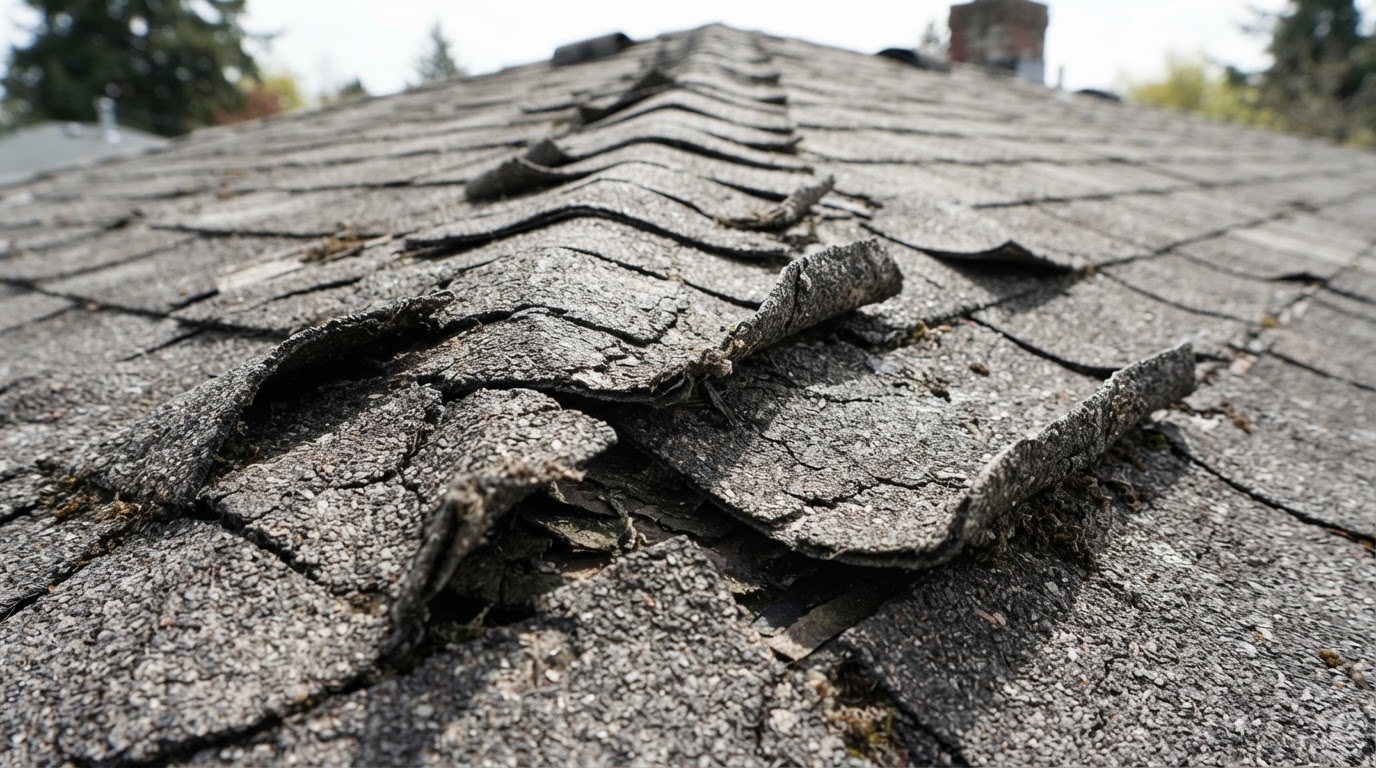
Asphalt shingles are designed to stay flexible so they can expand and contract with Middle Tennessee's temperature swings and shed water reliably. When they start to curl at the edges, crack down the center, or blister, the asphalt compound is drying out and hardening — and the waterproofing layer is weakening.
A few curled or cracked shingles in one spot may be repairable, especially after a single storm. But when curling, cracking, or blistering is visible across large sections of the roof, the shingles are failing as a system. At that point, patching individual shingles tends to buy weeks or months rather than years.
Middle Tennessee's hot, humid summers speed up this drying process. Heat and ultraviolet exposure gradually make asphalt brittle, which is why widespread shingle deterioration is one of the clearest signs a roof is nearing the end of its useful life.
2. Missing or Damaged Shingles Across Multiple Areas
A shingle or two blown loose after a spring storm is common across Nashville, Franklin, Brentwood, and the rest of Middle Tennessee, and a small, localized patch is often a straightforward repair. The bigger concern is shingles missing or torn across several areas of the roof — different slopes, different elevations, or both.
Widespread missing shingles usually point to a deeper problem: aging adhesive strips, failing sealant, wind-rated shingles that have lost their wind resistance over time, or a roof that has taken repeated storm hits. The National Weather Service considers a thunderstorm severe when it produces wind gusts of 50 knots (about 58 mph) or greater, and Middle Tennessee's spring and summer storms regularly meet that bar.
When the same roof keeps losing shingles in storm after storm, the shingles' wind resistance is often declining — and replacement may make more sense than repairing the same spots year after year. A roof inspection can show whether the damage is isolated or systematic.
3. Significant or Widespread Granule Loss
The colored mineral granules on an asphalt shingle do two important jobs: they block ultraviolet light from reaching the asphalt underneath, and they provide fire resistance. Some granule loss is normal, especially on a newer roof and as a roof ages.
What deserves attention is heavy or accelerating granule loss — gritty piles in the gutters, granules washing out at the downspout discharge, or bald spots visible on the shingle surface. Once the granule layer thins, the asphalt below ages faster, which shortens the remaining life of the roof.
Granule loss by itself doesn't automatically mean you need a new roof. It has to be evaluated in context: the roof's age, how widespread the loss is, and whether the shingles still seal and lie flat. That's a judgment call best made during an inspection, not from a single gutter cleanout.
4. Recurring Roof Leaks or Water Intrusion
One leak, traced to a clear source — a cracked pipe boot, a failed flashing patch, a single damaged shingle — is usually repairable. A roof that keeps leaking, or that starts leaking in a new place every year, is telling you something different about its overall condition.
Recurring or multiple leaks often mean the roof's weatherproofing is failing broadly, not in one spot. Each leak can also cause hidden damage to the decking and insulation before it shows up inside, so repeated water intrusion deserves a closer look even when the stains seem small.
If you're actively dealing with a leak right now, our roof leak emergency guide covers the immediate steps to take safely. If leaks keep coming back, it's time to weigh whether repair or replacement is the better long-term answer.
5. Sagging or Visible Roof Deck / Structural Concerns
A roof should look straight and flat along its lines. A dip, wave, or visible sag — whether viewed from the street or from inside the attic — usually means the wooden decking underneath has absorbed moisture and begun to soften or rot. This is a structural concern, not a surface one.
Sagging deserves prompt professional evaluation because it can involve the decking, the rafters, or the supports that hold up the roof. Do not climb onto a sagging roof to inspect it yourself; the structure may be weaker than it looks, and a wet roof is dangerous to walk on.
This is the one sign where waiting tends to make the problem more expensive, not less. If you can see a dip or wave in your roof line, call a professional rather than assuming it can wait until the next storm passes.
6. Advanced Roof Age Combined With Other Warning Signs
Age is a useful starting point, but it is not a verdict by itself. A 20-year-old roof in good physical condition with no leaks may still have useful life, while a younger roof that has taken repeated hail hits and poor ventilation may already be failing.
How long an asphalt shingle roof lasts depends on the shingle type, installation quality, attic ventilation, maintenance, and storm exposure — not just the number on the warranty. Manufacturer warranties describe terms and limits, not guaranteed real-world service life; for example, GAF's standard 3-tab shingle warranty is a 25-year term, while architectural shingles carry longer terms, but actual Middle Tennessee service life is shaped by heat, humidity, and severe weather.
That's why age is best read together with the other signs on this list. For a deeper look at expected lifespan and what affects it, see our asphalt shingle lifespan guide.
7. Multiple Repairs or Problems Developing Across the Roof
There's no magic number of repairs that automatically tips a roof from repair to replace. But when problems keep showing up across different areas — a fixed leak here, replaced shingles there, a patched valley last year — the roof is telling you its overall condition is declining.
Repeated repairs can add up in both cost and risk. Each fix addresses the immediate symptom, but when failures are scattered across the roof, the underlying issue is usually that the roofing system as a whole is aging past the point where spot repairs hold up.
When repair bills keep returning, it's worth weighing the total against the cost and benefit of a full replacement. Our roof repair vs. replacement guide walks through how to think through that decision honestly.
When a Roof Problem May Still Be Repairable
A roof problem doesn't automatically mean a new roof. Replacement usually isn't needed when the damage is isolated, the rest of the roof is in sound condition, and the shingles still have a reasonable amount of useful life.
Examples that are often repairable: a few shingles torn by one storm, a single leak from a cracked pipe boot or failed flashing, one damaged valley, or a small section of decking that can be opened and replaced without redoing the whole roof. Each one still needs an inspection to confirm the damage is truly local — water can travel along the decking before it shows up inside.
When a roof repair will honestly solve the problem, that's what should happen. The goal is the right fix for the actual condition of the roof, not the most expensive option. And if you have been told you need a full replacement but you are not yet sure the warning signs add up to one, it can make sense to get another opinion before replacing your roof — a second qualified inspection can confirm whether the recommendation fits the actual condition of the roof. If you are evaluating a repair proposal rather than a full replacement, our roof repair estimate checklist explains what the written estimate should include.
When Roof Replacement Becomes More Likely
Replacement becomes worth evaluating when warning signs stack up: widespread shingle deterioration, leaks in multiple areas, a sagging roof line, heavy granule loss, a roof near or past its service life, or repeated repairs across several seasons.
No single factor is decisive on its own. It's the combination that matters — an aging roof that also leaks in two rooms and has shingles curling across the south slope is a very different picture than an aging roof with no other issues.
A full roof replacement is a bigger decision and a bigger investment, so it should be based on the actual condition of your roof, not a rule of thumb. That's what a free inspection is for.
Storm Damage vs. Normal Roof Aging
Storm damage and normal aging are different things, and they're worth telling apart. Normal aging shows up gradually — slow granule loss, some shingle wear, eventual curling over many seasons. Storm damage shows up suddenly after a specific event: hail, high wind, a fallen limb, or a tree strike.
Hail can bruise the shingle mat and knock granules loose without leaving anything obviously broken from the ground, which is why post-storm damage often goes unnoticed until a later leak or an inspection reveals it. Wind can tear shingles off or lift and break their seal, which may not leak right away but leaves the roof exposed to the next storm.
If you suspect storm damage, our storm and hail damage guide goes deeper into what to look for and when to have it documented.
Why Middle Tennessee Roofs Need to Be Evaluated in Context
Middle Tennessee roofs aren't aging in a vacuum. The region sits in an active severe-weather corridor — the National Weather Service forecast office in Nashville covers the area, and spring and summer bring the bulk of the severe thunderstorms, hail, and straight-line wind events that shorten shingle life.
Heat and humidity matter too. Long, hot summers with high humidity stress asphalt shingles and accelerate the drying and granule loss that eventually end a roof's service life. Heavy rainfall finds weak flashing and seal points and turns small gaps into active leaks.
That means a Middle Tennessee roof of a given age may be in very different shape than the same-age roof in a milder climate. Local storm history, ventilation, and the specific shingle product all have to be weighed together — which is exactly why a one-size-fits-all age rule doesn't work.
What Homeowners Can Check Safely
You don't need to climb onto your roof to spot several warning signs. Most of the useful checks happen safely from the ground and inside the house.
From the ground or a safe vantage point: look for shingles missing across different roof areas, a roof line that dips or sags, and shingle debris or large amounts of granules in the yard or at the downspout discharge after a storm.
Inside: check ceilings and the top of exterior walls for new water stains, and look in the attic (from the access hatch, safely) for daylight through the decking, damp insulation, or darkened wood that can point to moisture intrusion.
These observations help you know when to call a professional. They don't replace a hands-on inspection — but they tell you whether one is warranted.
Warning Signs You Can Check Safely From the Ground and Inside
- Ceiling stains or new water marks on walls
- Shingles missing across more than one roof area
- A roof line that dips, waves, or sags
- Shingle debris or heavy granules in the yard or at the downspouts
- Daylight visible through the attic decking
- Damp insulation or darkened wood in the attic
Have a question about your roof?
Terry personally answers the phone — no sales reps, no pressure.
Frequently Asked Questions
Straight answers to common questions from Middle Tennessee homeowners.
How do I know if my roof needs to be replaced?
A roof may need replacement when several warning signs appear together — widespread curling or cracking shingles, shingles missing across multiple areas, heavy granule loss, recurring leaks, a sagging roof line, advanced age combined with other damage, or repeated repairs across the roof. No single sign is automatic; a free inspection confirms the actual condition. Terry Woodall Roofing offers free inspections across Middle Tennessee — call (615) 300-6005.
Does a 20-year-old roof automatically need replacement?
No. Age is a starting point, not a verdict. A 20-year-old roof in good physical condition with no leaks may still have useful life, while a younger roof with poor ventilation and storm damage may already be failing. Shingle type, installation quality, ventilation, maintenance, and storm exposure all matter. An inspection is the only way to judge how much life a specific roof has left.
Can missing shingles be repaired?
Often, yes — if only a few shingles are missing in one area and the rest of the roof is sound. A localized patch is a common repair after a single storm. But shingles missing across several roof areas usually point to declining wind resistance or broader failure, which may call for a larger evaluation rather than another patch.
Does granule loss mean I need a new roof?
Not by itself. Some granule loss is normal, especially as a roof ages. What matters is how heavy and widespread it is and whether it's accelerating. Light, age-consistent granule loss can be fine; heavy granule piles in the gutters or bald spots on the shingles deserve an inspection. Granule loss is best evaluated alongside the roof's age and overall condition.
Does one roof leak mean I need a roof replacement?
Not usually. One leak with a clear source — a cracked pipe boot, failed flashing, or a single damaged shingle — is typically repairable. Replacement becomes more likely when leaks keep recurring or appear in multiple areas, which suggests the roof's weatherproofing is failing broadly rather than in one spot.
Is a sagging roof serious?
Yes. A sagging roof line usually means the decking or supports underneath have absorbed moisture and weakened, which is a structural concern. It deserves prompt professional evaluation. Do not climb onto a sagging roof yourself — it may be weaker than it appears, and a wet roof is dangerous to walk on.
Should a roof be replaced after hail damage?
Not always. Isolated, repairable hail damage may not require a full replacement. But hail can bruise the shingle mat and loosen granules without leaving obvious visible damage, and widespread hail impact across the roof can shorten its life enough that replacement makes more sense than repeated repairs. An inspection after any significant hailstorm can confirm the extent of the damage.
Is it better to repair or replace an older roof?
It depends on the roof's overall condition, not just its age. An older roof with one isolated problem may be repairable; an older roof that also leaks in several areas and has shingles failing across multiple slopes is usually better replaced. The right call comes from weighing remaining useful life, the cost of continued repairs, and the extent of the damage together.
How can I tell storm damage from normal roof aging?
Storm damage appears suddenly after a specific event — hail, high wind, a fallen limb — while normal aging shows up gradually over seasons. Sudden missing or torn shingles, fresh granule piles in the yard, and a new leak shortly after a storm point to storm damage. Slow, even wear across the roof points to aging. When it's unclear, an inspection can tell the two apart.
Does Terry Woodall Roofing offer free roof inspections?
Yes. Terry Woodall Roofing offers free roof inspections within its Middle Tennessee service area. Terry personally answers the business phone at (615) 300-6005, and a free inspection can confirm whether your roof needs a repair or a replacement — with honest, straightforward recommendations.
Terry Woodall Roofing Contractors
From the Terry Woodall Roofing Contractors Resource Center — serving Middle Tennessee homeowners since 1983
Terry Woodall Roofing Contractors brings over 40 years of hands-on roofing experience to Middle Tennessee homeowners. These resources are prepared to help homeowners understand roof maintenance, storm damage mitigation, and the insurance claims process so every home is protected. Founder Terry Woodall personally oversees the company's roofing work across Nashville, Franklin, Brentwood, and the surrounding communities.
Found this guide useful? Copy a ready-to-paste citation and attribute Terry Woodall Roofing as your source.
Terry Woodall. (2026-08-12). When Is It Time to Replace Your Roof? 7 Signs Middle TN Homeowners Shouldn't Ignore. Terry Woodall Roofing. https://terrywoodallroofing.com/resources/signs-you-need-roof-replacement
Related Roofing Services
If you suspect your roof needs attention, Terry Woodall offers straightforward evaluations across Middle Tennessee:
Where We Work in Middle Tennessee
Keep Reading
Request a Call
Get straightforward answers directly from Terry.
Free roof inspection — and free estimates on any recommended work.
This form is for Middle Tennessee homeowners requesting roofing help only. Marketing, sales, and vendor solicitations are not accepted and will be discarded.
Need an Honest Roof Inspection?
Speak directly with Terry Woodall today. No pushy sales representatives, just a local reputation built since 1983.
Call (615) 300-6005Text TerryNot sure whether your roof needs a repair or a replacement? Terry Woodall Roofing provides straightforward roof inspections and honest recommendations across Middle Tennessee — serving the area since 1983. Call (615) 300-6005 to speak with Terry directly.