
What Should a Roof Repair Estimate Include? A Middle Tennessee Homeowner's Checklist
Got a roof repair estimate and not sure if it's complete? Use this Middle Tennessee homeowner checklist to review the scope, leak source, materials, warranty, and change-order terms before you approve the work.

- 1.Roof Repair Estimate Checklist
- 2.1. Contractor and Project Information
- 3.2. The Leak Source or Damage Location
- 4.3. A Clear Scope of Work
- 5.4. The Specific Roofing Materials
- 6.5. Underlayment and Water-Protection Components
- 7.6. How Hidden Damage Will Be Handled
- 8.7. Flashing and Roof Penetrations
- 9.8. Cleanup and Disposal
- 10.9. Project Timing
- 11.10. Payment Terms
- 12.11. How Changes and Unexpected Work Are Approved
- 13.12. Warranties
- 14.13. The Total Price — and What Is Not Included
- 15.Don't Compare the Bottom Line Until You Understand the Scope
- 16.Questions to Ask Before Approving a Roof Repair Estimate
- 17.Red Flags When Reviewing a Roof Repair Estimate
- 18.What If You're Not Sure You Need the Repair?
- 19.What If You're Actually Considering a Full Replacement?
- 20.Get Clear Answers Before You Approve a Roof Repair
A roof repair estimate should clearly identify the leak source or damage location, describe the scope of work, specify the materials being installed, address how hidden conditions like rotted decking will be handled, state any warranty, explain the total price and what is and is not included, and outline how additional work would be documented and approved. Tennessee consumer guidance recommends detailed, itemized bids and written agreements for home-repair work. Terry Woodall Roofing Contractors provides free roof inspections across Middle Tennessee — call (615) 300-6005.
Key Takeaways for Middle Tennessee Homeowners
- A roof repair estimate should tell you the leak source or damage location, the scope of work, the materials being used, any warranty, the total price, and how unexpected conditions will be handled.
- Repair estimates are shorter than full replacement proposals, but they should still be specific enough that you understand what work is being done before you approve it.
- Tennessee consumer guidance recommends detailed, itemized bids and written agreements rather than verbal quotes for home-repair work.
- The roofer's job is to evaluate the physical roof and document the condition — a contractor cannot guarantee an insurance outcome or determine your coverage.
- Terry Woodall Roofing Contractors has served Middle Tennessee since 1983, provides free roof inspections, and Terry personally answers the business phone at (615) 300-6005.
A good roof repair estimate should tell you what work is being proposed, which materials are being installed, what is included in the price, how any unexpected conditions will be handled, and what warranty you will receive. Before you approve a repair, you should be able to look at the written estimate and understand what the roofing contractor plans to do.
Repair estimates are generally shorter and less complex than full roof replacement proposals, but that does not mean they should be vague. Tennessee consumer guidance recommends detailed, itemized bids and written agreements for home-repair work rather than relying on verbal quotes. The National Roofing Contractors Association similarly recommends written proposals with complete descriptions of the work.
Use the checklist below to review a roof repair estimate before signing. If you are researching what drives the price of a repair rather than what the estimate should contain, see our separate roof repair cost guide, which covers repair pricing factors. This checklist has a different job: helping you determine whether the estimate clearly describes what you are buying.
Roof Repair Estimate Checklist
A roof repair estimate should clearly address the major parts of the proposed job, including the contractor and project information, the leak source or damage location, the scope of work, the specific roofing materials, any underlayment or water-protection components, how hidden damage will be handled, flashing and penetrations when applicable, cleanup and disposal, project timing, payment terms, how additional work will be approved, warranties, and the total proposed price.
The exact scope will vary by repair. The important thing is being able to tell what the contractor is proposing — and what may not be included.
1. Contractor and Project Information
Start with the basics. The written estimate should clearly identify the contractor and the property where the work will take place. Before moving forward, make sure you know who is performing the work, how to contact the company, and which property the estimate covers.
Tennessee consumer guidance recommends verifying a contractor's identity and address, checking references, and confirming appropriate contractor licensing. The state provides an online contractor-license verification system. An estimate also gives you a natural opportunity to confirm any contractor credentials that matter to your decision rather than relying on verbal claims.
2. The Leak Source or Damage Location
One of the most important parts of a repair estimate is a clear identification of the problem. The estimate should tell you where the damage is located and, when applicable, what the contractor identified as the leak source.
This matters because water often travels along the decking before it drips inside, so the ceiling stain is rarely directly below the actual entry point. A repair that only patches the spot above the drip usually fails because it never addresses the source. For step-by-step guidance on what to do the moment you find a leak, see our roof leak emergency guide.
3. A Clear Scope of Work
The scope of work tells you what the contractor is actually agreeing to do. For a repair, the scope should make it reasonably clear which components are being replaced or resealed, how much area is involved, and what the repair is designed to address.
A vague line such as "fix roof" leaves important questions unanswered. The proposal does not need to read like a roofing textbook, but a homeowner should be able to understand the major work being proposed. If the repair involves reaching below the shingle surface — such as replacing a section of rotted decking — that should be reflected in the written scope.
4. The Specific Roofing Materials
An estimate should give you enough information to understand which roofing material or component is being installed. For an asphalt-shingle repair, look for more specificity than a description such as "replace shingles." The proposal may identify the manufacturer, product line, shingle type or tier, and selected color or the process for selecting it.
This matters because the written estimate should reflect the materials you actually expect to receive. Tennessee consumer guidance specifically recommends being clear about selected materials. If the repair involves a different component — a pipe boot, flashing, valley metal — the estimate should identify that component rather than leaving you to assume.
5. Underlayment and Water-Protection Components
Shingles are only one part of the repair. When the repair exposes the roof deck, the proposal should identify the underlayment and other water-protection components included where applicable, such as ice and water barrier in a valley or along an eave.
The exact materials depend on the roof design and the extent of the repair, but homeowners should not have to assume what is going beneath the shingles. If a component is important to the repair but is not clear in the estimate, ask the contractor to explain it before accepting the proposal.
6. How Hidden Damage Will Be Handled
Some damage remains hidden until the repair area is opened. Roof decking is a common example — a contractor may not know the full extent of rot until the shingles above it are removed. That creates an important estimate question: what happens if damaged decking or additional rot is discovered during the repair?
The estimate or contractor should explain the process for handling additional work if it becomes necessary. You may want to know how you will be notified, how the additional work will be documented, how it will be priced, and how approval will be handled. For a deeper look at per-sheet decking pricing, OSB versus plywood, and how decking charges should be documented, see our roof decking replacement cost guide.
7. Flashing and Roof Penetrations
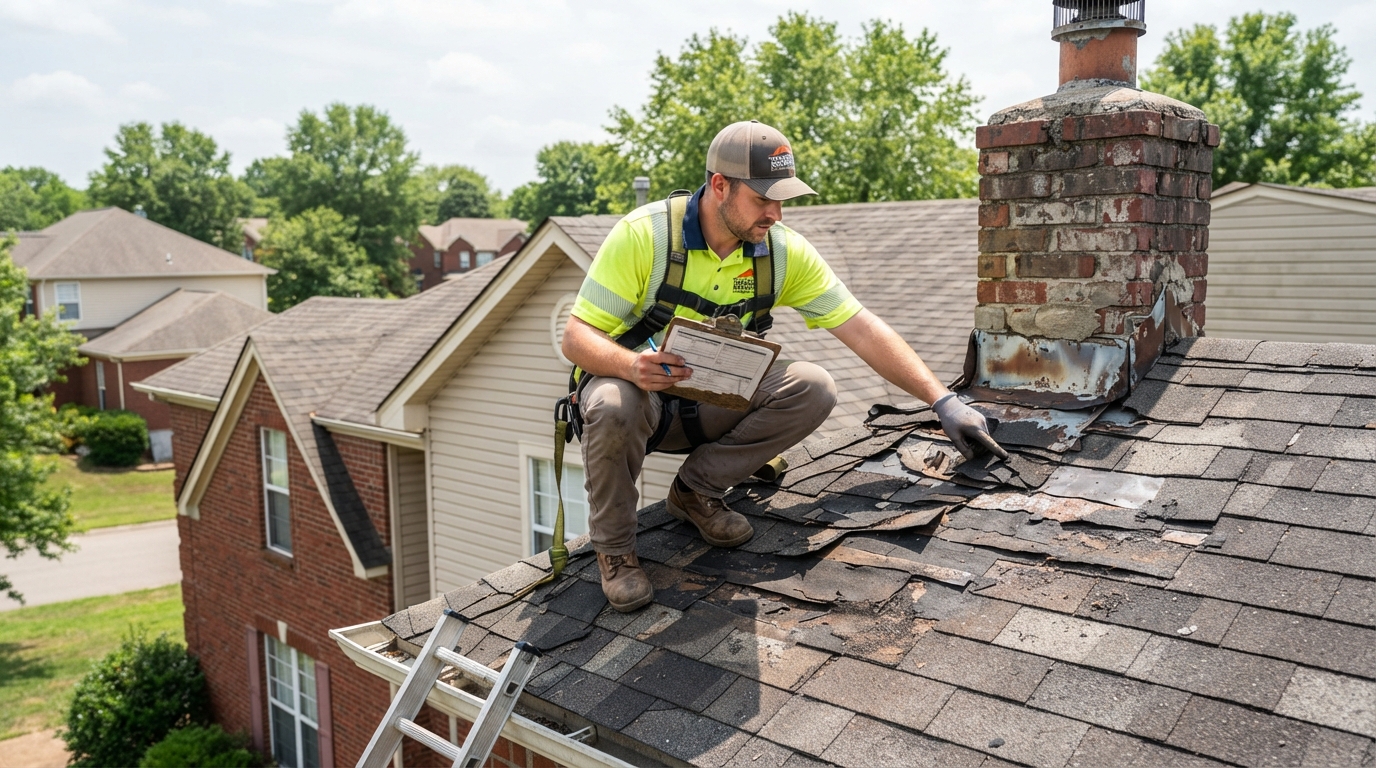
When the repair involves a penetration or a seam, flashing and water-management details deserve attention in the estimate. Depending on the home, relevant areas may include chimneys, plumbing vents and pipe boots, skylights, valleys, or roof-to-wall intersections.
The estimate should make clear enough what is happening at these areas that you are not left assuming everything is automatically replaced. Ask what flashing will be replaced, what may remain, and how significant penetrations are addressed in the proposed scope.
8. Cleanup and Disposal
Even a repair generates job-site debris. The proposal should tell you whether removal, disposal, and cleanup are part of the job. Useful items to clarify can include removal of torn-off roofing material, disposal of roofing debris, general job-site cleanup, and nail cleanup around the property.
These details may seem small compared with the repair itself, but they are part of understanding what the contractor considers a completed project.
9. Project Timing
Roofing schedules can be affected by weather and other legitimate job conditions, so timing is not always exact. Still, before accepting the work, you should understand when the repair is expected to begin, the expected duration, how weather delays will be handled, and how schedule changes will be communicated.
The National Roofing Contractors Association recommends including start and completion information in the written proposal. Tennessee consumer guidance likewise recommends specifying beginning and completion dates in the written agreement.
10. Payment Terms
The written estimate or contract should clearly explain payment expectations. Before approving the repair, understand the total proposed price, any required deposit, when subsequent payments are due, what triggers final payment, and how approved additional work would affect the amount due.
Tennessee consumer guidance recommends that written home-repair contracts identify the total cost and payment schedule and advises consumers not to rely on verbal agreements. If the payment arrangement you were told verbally differs from the written documents, get the discrepancy resolved before signing.
11. How Changes and Unexpected Work Are Approved
A contractor cannot necessarily see every condition beneath the existing roofing before the repair begins. That makes the process for changes important. For example, if removing shingles exposes deteriorated decking, you should understand how the contractor will communicate the condition, explain the additional work, and document any change in price.
Tennessee consumer guidance recommends that changes to a home-repair contract be put in writing. A clear process for changes helps distinguish the original estimate from additional work that becomes necessary later.
12. Warranties
Do not treat the word "warranty" as enough information by itself. Ask which warranties apply and what each one covers. A roof repair may involve a manufacturer warranty associated with a roofing product and a separate workmanship warranty from the contractor.
You should be able to determine what product or manufacturer warranty applies, whether the contractor provides a workmanship warranty, who is responsible for each warranty, and what important conditions or exclusions apply. For more detail about roofing warranties specifically, use our roofing warranties explained resource rather than expecting the estimate itself to explain every warranty provision.
13. The Total Price — and What Is Not Included
Naturally, a roof repair estimate needs a proposed total price. But the figure should be read together with the written scope. Before accepting the proposal, make sure you understand what work is included in the stated price, which components are included, whether any known work is excluded, which hidden conditions could require additional approved work, and how additional work would be handled.
For homeowners researching what determines the price of a repair, the existing roof repair cost guide covers that separate subject in detail. This checklist has a different job: helping you determine whether the estimate clearly describes what you are buying.
Don't Compare the Bottom Line Until You Understand the Scope
Before accepting an estimate, make sure the written proposal answers the major questions about the project: what product is being installed, what existing roofing is being removed, what happens if damaged decking is found, what flashing work is included, whether debris removal and cleanup are included, which warranties apply, and how changes are documented and approved.
The purpose of this exercise is not to determine which contractor has the better price. It is to make sure you understand the proposal in front of you.
Questions to Ask Before Approving a Roof Repair Estimate
Before approving an estimate or signing a contract, ask: What is the leak source or damage location? Is the damage isolated, or is there broader wear? Which exact shingle product or component are you proposing? Which underlayment or water-protection components are included? How will damaged decking be handled if it is discovered? What flashing work is included? Are removal, disposal, and cleanup included? What could require additional work beyond the original scope? How will changes be documented and approved? What manufacturer warranty applies? What workmanship warranty applies? What are the payment terms? What is the expected project schedule?
If an important answer is unclear, ask for clarification before accepting the estimate. For a broader list of questions to ask before approving a repair, see the questions section in our roof repair cost guide.
Red Flags When Reviewing a Roof Repair Estimate
A short estimate is not automatically a poor estimate, and a long estimate is not automatically a good one. The important question is whether you can clearly understand the proposed work. Ask for more information when the scope is vague, roofing materials are not clearly identified, important work is discussed verbally but is missing from the written proposal, the process for additional work is unclear, payment terms are unclear, warranty information is vague, you are being pressured to approve the job before you understand it, or the contractor is unwilling to provide written terms.
Tennessee consumer guidance recommends detailed bids and written agreements, while the NRCA advises homeowners to evaluate contractors on more than price alone. If a repair recommendation seems much larger than the visible issue that caused you to call, or if you are simply uncertain whether the proposed work is necessary, read our guide on whether to get a second opinion on your roof.
What If You're Not Sure You Need the Repair?
An estimate checklist is useful once a repair is being considered, but it does not determine whether the repair is actually necessary. Some roofing problems may not need the work being proposed; others may actually warrant replacement rather than a repair.
If you have been told you need a repair but are still deciding, read our roof repair vs. replacement guide or have the roof inspected before committing. Terry Woodall Roofing's positioning is especially relevant at this stage: the goal is to identify the work the roof actually needs rather than treating any recommendation as automatic when a smaller solution can solve the problem.
What If You're Actually Considering a Full Replacement?
This checklist is written for roof repair estimates, which are shorter and less complex than full replacement proposals. If the estimate in front of you is for a complete tear-off and new roof, use our separate roof replacement estimate checklist instead, which covers the additional scope a replacement involves — tear-off, decking process, ventilation, ice and water barrier, and the larger material system.
If you have gathered multiple replacement proposals and they do not match, our guide on why roofing estimates differ explains how to compare competing quotes fairly.
Get Clear Answers Before You Approve a Roof Repair
A roof repair estimate should make your decision easier, not leave you guessing about what you are buying. If you are considering a roof repair in Middle Tennessee and want the roof evaluated first, Terry Woodall Roofing Contractors offers free roof inspections within its service area. Terry personally answers the business phone, and the company's approach is to inspect the roof first and recommend the work the roof actually needs — including a repair when a repair reasonably solves the problem.
Call Terry directly at (615) 300-6005 or request a free roof inspection.
Have a question about your roof?
Terry personally answers the phone — no sales reps, no pressure.
Frequently Asked Questions
Straight answers to common questions from Middle Tennessee homeowners.
What should be included in a roof repair estimate?
A roof repair estimate should clearly describe the leak source or damage location, the scope of work, the roofing materials and components, how hidden damage will be handled, flashing and penetrations when applicable, cleanup and disposal, project timing, payment terms, warranties, the total proposed price, and how additional work will be handled. The goal is to understand what the contractor is proposing before you accept the work.
Should roof repair estimates be itemized?
Tennessee's consumer guidance recommends that bids for home-repair work be itemized and detailed and that contractors bid on the same work when homeowners obtain multiple estimates. For a roofing repair, the estimate should provide enough detail for you to understand the important materials and work being proposed.
Should I choose the lowest roof repair estimate?
Price should not be the only factor you consider. The NRCA advises homeowners to use healthy skepticism when evaluating the lowest bid and states that price is only one criterion in selecting a roofing contractor. A lower quote can still be legitimate, but the important question is whether it represents comparable work from a properly qualified contractor with clear terms.
What if a roofer finds bad decking during a repair?
Some decking damage may remain hidden until the area is opened. Before the repair begins, ask how unexpected decking replacement will be documented, priced, and approved. The estimate should give you a clear process for work that may fall outside the original scope. For per-sheet decking pricing and documentation guidance, see our roof decking replacement cost guide.
Should flashing be listed in a roof repair estimate?
When the repair involves a penetration or a seam, the proposal should address flashing where it is relevant. Ask what is being done around chimneys, valleys, roof-to-wall intersections, plumbing penetrations, or skylights rather than assuming all flashing work is automatically included.
Should a roof repair estimate include warranty information?
Warranty information should be clear before you commit to the work. Ask separately about any manufacturer or product warranty coverage and the contractor's workmanship warranty. The NRCA recommends reading the warranty carefully and understanding provisions that can void coverage.
How is a roof repair estimate different from a replacement estimate?
A repair estimate is generally shorter and less complex because it addresses an isolated problem rather than a full roofing system. A full replacement proposal covers additional scope such as tear-off, the decking process across the whole roof, ventilation, ice and water barrier, and the complete material system. If the estimate in front of you is for a full replacement, use our roof replacement estimate checklist instead.
Should I get more than one roof repair estimate?
Tennessee consumer guidance recommends getting at least three estimates and making sure contractors bid on the same work. If you collect multiple proposals, first make sure you understand what each estimate includes before comparing the bottom-line totals.
Terry Woodall Roofing Contractors
From the Terry Woodall Roofing Contractors Resource Center — serving Middle Tennessee homeowners since 1983
Terry Woodall Roofing Contractors brings over 40 years of hands-on roofing experience to Middle Tennessee homeowners. These resources are prepared to help homeowners understand roof maintenance, storm damage mitigation, and the insurance claims process so every home is protected. Founder Terry Woodall personally oversees the company's roofing work across Nashville, Franklin, Brentwood, and the surrounding communities.
This guide relies on authoritative industry standards, building code regulations, and verifiable research from recognized organizations:
Found this guide useful? Copy a ready-to-paste citation and attribute Terry Woodall Roofing as your source.
Terry Woodall Roofing Contractors. (2026-09-14). What Should a Roof Repair Estimate Include? A Middle Tennessee Homeowner's Checklist. Terry Woodall Roofing. https://terrywoodallroofing.com/resources/what-should-roof-repair-estimate-include
Related Roofing Services
If you suspect your roof needs attention, Terry Woodall offers straightforward evaluations across Middle Tennessee:
Where We Work in Middle Tennessee
Keep Reading
Request a Call
Get straightforward answers directly from Terry.
Free roof inspection — and free estimates on any recommended work.
This form is for Middle Tennessee homeowners requesting roofing help only. Marketing, sales, and vendor solicitations are not accepted and will be discarded.
Need an Honest Roof Inspection?
Speak directly with Terry Woodall today. No pushy sales representatives, just a local reputation built since 1983.
Call (615) 300-6005Text TerryHave the roof inspected and get a clear repair recommendation. Terry Woodall Roofing Contractors has served Middle Tennessee since 1983, provides free roof inspections, and Terry personally answers the business phone. Call Terry directly at (615) 300-6005 or request a free roof inspection.