
Storm & Hail Roof Damage Guide for Middle Tennessee (2026): Signs, Insurance & Repair
How to identify wind and hail roof damage after Middle Tennessee storms, what impact-resistant shingles do, how insurance claims work, and when to repair vs. replace — with honest, inspection-first guidance from Terry Woodall Roofing.
- 1.Why Middle Tennessee Gets So Much Hail and Wind Damage
- 2.How to Identify Hail Damage on Asphalt Shingles
- 3.How to Identify Wind Damage on Asphalt Shingles
- 4.Impact-Resistant Shingles: Do They Help in Middle Tennessee?
- 5.Wind Warranties From GAF, CertainTeed & Owens Corning
- 6.The Insurance Claim Process After Storm Damage
- 7.Repair vs. Replacement After Storm Damage
- 8.What to Do Immediately After a Middle Tennessee Storm
After a Middle Tennessee storm with hail or strong winds, look for dented gutters and downspouts, granules piling up in gutters and downspout runoff, soft dark spots on shingles where granules dislodged, and creased or lifted shingle edges. Hail often bruises the shingle mat without breaking the surface, so damage can be invisible from the ground — a ground-to-roof inspection is the only reliable way to confirm it. Terry Woodall Roofing provides free storm damage inspections across Middle Tennessee and documents the condition of the roof so you have the information you need when working with your insurance company. Call (615) 300-6005.
Key Takeaways for Middle Tennessee Homeowners
- Middle Tennessee sits in an active severe-weather corridor — the National Weather Service records large hail (3/4 inch or larger) somewhere in the region nearly every year, with spring and early summer the peak season.
- Hail often bruises the shingle mat and knocks granules loose without breaking anything you can see from the ground, so hidden damage is common after any storm that produced hail.
- Wind lifts and creases shingles where the factory seal strip fails, exposing nail heads to rust and rainwater on the next storm.
- Impact-resistant (Class 4) shingles from manufacturers like GAF, CertainTeed, and Owens Corning can reduce hail damage and may earn Tennessee homeowners an insurance discount.
- Terry Woodall Roofing documents storm damage honestly with photos, meets your adjuster on-site, and only recommends an insurance claim when the damage truly warrants it.
Middle Tennessee sits squarely in one of the country's most active severe-weather corridors. The National Weather Service defines a severe thunderstorm as one that produces hail 1 inch or larger, winds of 58 mph or greater, or a tornado — and the NWS Nashville office (weather.gov/ohx) logs these events across the region every spring and summer. The NWS severe-weather climatology for Tennessee shows that large hail has been reported somewhere in the state every year on record, with the peak months falling in spring and early summer and the greatest frequency in the late afternoon and early evening. (Source: NWS Severe Weather Climatology)
That weather pattern has real consequences for your roof. Hail strikes can fracture the inner fiberglass mat of an asphalt shingle and knock loose the mineral granules that block UV rays, even when the surface looks intact from the ground. High winds lift and crease shingles where the factory sealant strip fails, exposing nail heads to rust and rainwater. And Middle Tennessee's intense summer heat and humidity then accelerate the damage by drying out sealants and baking already-weakened shingles. (Source: NWS Nashville Event Overviews)
This guide walks through how to recognize storm and hail damage, what impact-resistant shingles from manufacturers like GAF, CertainTeed, and Owens Corning actually do, how the insurance claim process works in Tennessee, and when a repair is enough versus when replacement is the better long-term choice. Terry Woodall Roofing is inspection-first: Terry documents damage honestly and never pushes an unnecessary claim or replacement. If you have had a storm recently, start with a free storm damage inspection. For the specific question of who to call first — a roofer or your insurance company — see our guide on what to do first after storm roof damage.
Storm Damage: Repair vs. Replacement at a Glance
Use this as a general guide, not a hard rule. Every situation still needs an in-person inspection to weigh the factors together.
| Situation | Repair may make sense | Replacement may make sense |
|---|---|---|
| Hail damage extent | Bruises confined to one slope or section | Widespread bruising and granule loss across the roof |
| Wind damage extent | A few creased or missing shingles in one area | Many lifted or torn shingles across multiple slopes |
| Roof age | Newer roof with plenty of useful life remaining | Roof already near the end of its service life |
| Pre-existing condition | Shingles otherwise sound before the storm | Already curling, cracking, or losing granules |
| Number of leaks | One isolated leak from the storm damage | Leaks appearing in multiple areas |
| Decking condition | Dry, solid decking beneath the damaged area | Rotted or water-damaged decking found during tear-off |
| Insurance scope | Damage below or near your deductible threshold | Damage clearly exceeding the deductible |
| Long-term value | Repair restores full protection at low cost | Repeated repairs would approach replacement cost |
| Future hail resistance | Standard shingles match the existing roof | Upgrade to Class 4 impact-resistant shingles |
| Remaining useful life | Most of the roof's service life still ahead | Little useful life left even after repairs |
Why Middle Tennessee Gets So Much Hail and Wind Damage
Middle Tennessee's geography makes it a natural target for severe thunderstorms. Warm, humid air from the Gulf of Mexico collides with cooler, drier air masses moving in from the north and west, fueling the kind of instability that produces large hail, damaging straight-line winds, and occasional tornadoes. The NWS Nashville office covers a large swath of Middle Tennessee including Davidson, Williamson, Cheatham, Dickson, and surrounding counties, and its event archives document repeated significant hail and wind events year after year. (Source: NWS Nashville)
Recent history makes the point clearly. In January 2026, a historic ice storm (referred to in the media as Winter Storm Fern) caused roughly $80 million in damage across the Nashville area, crippling the power grid and damaging homes and businesses. In February 2025, a tornado outbreak struck Middle Tennessee under a Level 2 severe-weather risk. And every spring, the NOAA Storm Prediction Center logs hail reports across the region — you can see the daily hail and wind reports yourself on the SPC storm reports page. None of this means every roof fails, but it does mean that weather exposure has to be part of every repair-or-replacement decision here.
How to Identify Hail Damage on Asphalt Shingles
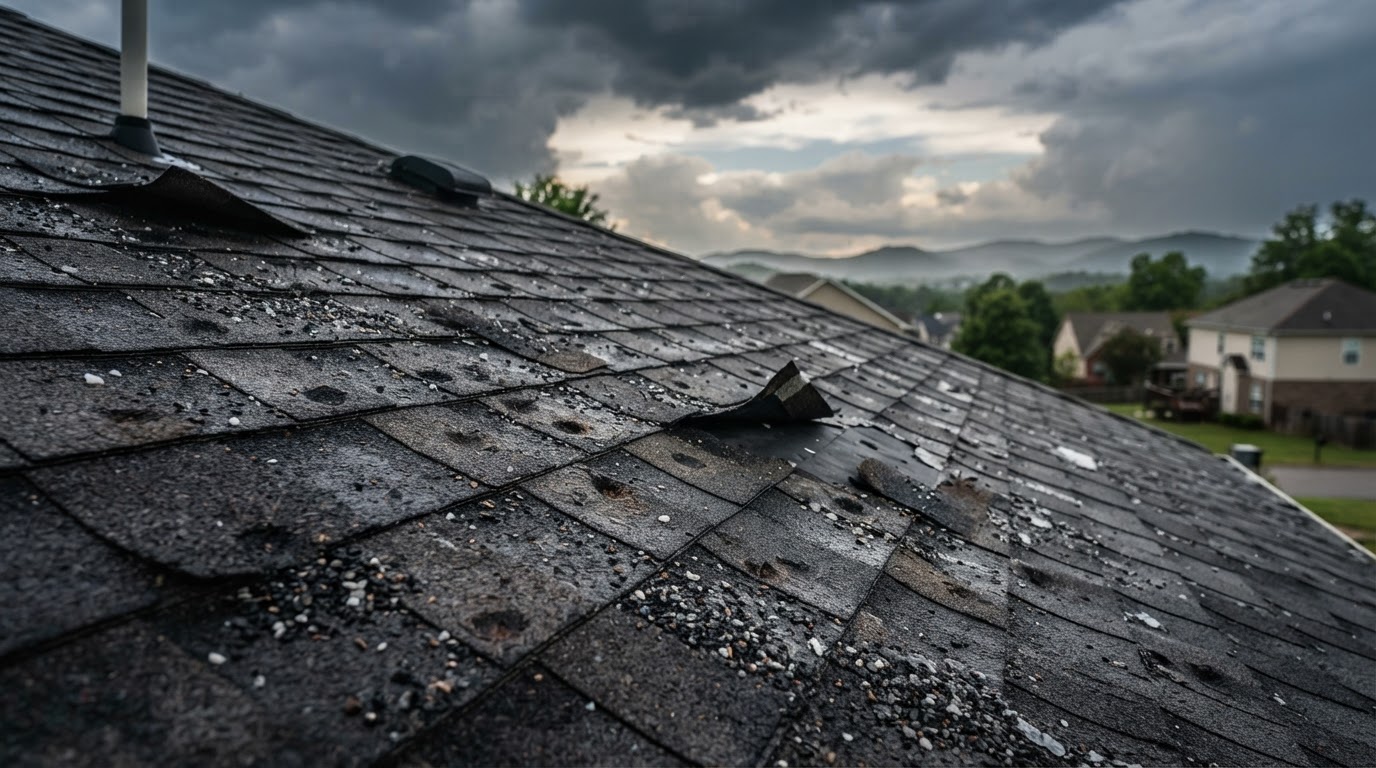
Hail damage is notoriously hard to spot from the ground because the most serious harm happens beneath the surface. When a hailstone strikes an asphalt shingle, it can fracture the inner fiberglass mat and dislodge the protective mineral granules without tearing the visible top layer. The result is a soft, dark bruise on the shingle — a spot where the waterproofing has been compromised even though nothing looks broken. Over months and seasons, those bruises allow water to penetrate and shorten the roof's life. (Source: IBHS Hail Protection Research)
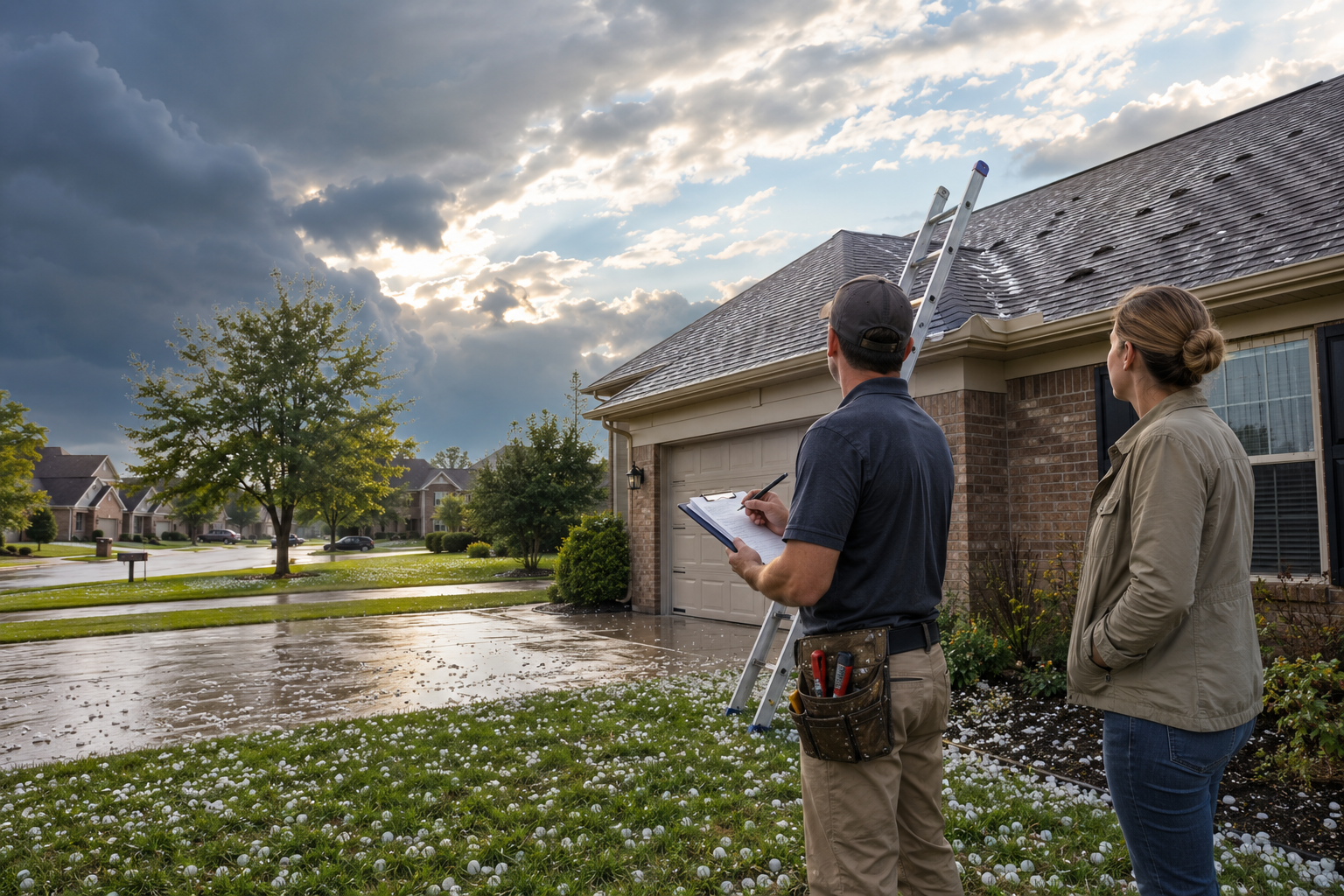
There are a few ground-level clues homeowners can check safely. Look for dents or dimples on metal gutters, downspouts, flashing, and vent caps — soft metal holds hail impact marks well. Check your gutters and the ground beneath downspouts for an unusual buildup of gritty granules after a storm. And inspect any shingle debris blown into your yard for creases or granule loss. These are signs worth a professional inspection, but they are not a substitute for one. Terry performs a ground-to-roof evaluation and documents every impact with photos. For an honest assessment, schedule a free roof inspection.
How to Identify Wind Damage on Asphalt Shingles
Wind damage usually looks different from hail damage. High winds lift the leading edge of a shingle, and once the factory sealant strip breaks, the shingle can crease horizontally where it bends back. That crease is a permanent weak point — the shingle will not reseal on its own, and the exposed nail heads beneath it become vulnerable to rust and water intrusion. In subsequent storms, creased and lifted shingles are far more likely to tear off entirely.
From the ground, look for shingles that appear lifted, curled, or bent at the edges, and for any shingles missing entirely — especially on the windward side of the roof or along ridges and edges where wind pressure is highest. Missing shingles after a storm are an obvious sign, but even a single creased shingle deserves attention because water can travel beneath the surrounding shingles before it shows up inside. If you see any of these signs, Terry can confirm whether a targeted roof repair will solve it or whether the damage is widespread enough to warrant replacement.
Impact-Resistant Shingles: Do They Help in Middle Tennessee?
Impact-resistant (IR) shingles are designed to better withstand hail strikes. They are rated under the UL 2218 test standard, which drops steel balls onto shingles from varying heights; Class 4 is the highest rating and Class 3 the next. Manufacturers including GAF, CertainTeed, and Owens Corning all offer Class 3 or Class 4 architectural shingles. For example, GAF's Timberline UHDZ with UltraMat carries a UL 2218 Class 4 impact-resistance rating, and CertainTeed's Landmark line carries a UL 2218 Class 3 rating. (Sources: GAF Class 4 Shingles, CertainTeed Landmark)
It is worth knowing that the UL 2218 rating is a standardized lab test, and real-world hail performance can vary. The Insurance Institute for Business & Home Safety (IBHS) developed its own, more rigorous hail impact test and publishes ratings from Poor to Excellent — its research found that some IR shingles do not perform as expected in real storms. If you are replacing a roof in a hail-prone part of Middle Tennessee, asking about the IBHS hail rating in addition to the UL 2218 class is a smart move. (Source: IBHS Hail Protection That Works)
There can also be a financial upside. Because impact-resistant shingles reduce hail claims, many insurance companies offer premium discounts for homes with Class 3 or Class 4 shingles — State Farm, for instance, lists roofing discounts for hail-resistant and Class 4 shingles, and the discount amount is set by each insurer. Availability varies by company and policy, so Terry recommends checking with your Tennessee insurance agent. (Sources: State Farm Roofing Discounts, IBHS FORTIFIED Incentives)
Wind Warranties From GAF, CertainTeed & Owens Corning
Wind performance matters just as much as hail resistance in Middle Tennessee. The major manufacturers back their architectural shingles with wind warranties when installed as a complete system with the required starter strips, underlayment, and ridge caps. GAF's WindProven Limited Wind Warranty is notable because it has no maximum wind speed limit and no named-storm exclusion when Timberline shingles with LayerLock Technology are installed with the required GAF accessories. (Source: GAF WindProven Warranty)
CertainTeed Landmark carries a 110 mph wind-resistance warranty standard, upgradeable to 130–160 mph when installed with the required CertainTeed system components. Owens Corning Duration shingles are commonly rated to 130 mph with proper installation, thanks in part to their SureNail fabric nailing strip. The key point for homeowners: a wind warranty only applies when the full roofing system is installed correctly, which is why proper installation by an experienced contractor like Terry matters as much as the shingle you choose. (Sources: CertainTeed Landmark)
The Insurance Claim Process After Storm Damage
Filing a roof insurance claim can feel intimidating, but the process is more manageable when you have honest documentation. The first step is always a professional inspection — Terry inspects the roof, identifies storm and hail damage, and documents the condition. You report the loss to your insurance company following the notice and proof-of-loss requirements in your individual policy, and the insurer sends an adjuster to inspect.
The adjuster inspection is an important step. Adjusters inspect many roofs, and a roofing contractor's documentation can help make sure the full scope of damage is considered. Terry has decades of experience working with Tennessee homeowners and insurance adjusters, and as one customer wrote on Google, Terry 'has a great deal of knowledge regarding insurance claims and shows up on time as promised.' For full claim support, see our insurance claim assistance page.
One honest note: whether to file a claim depends on your individual policy, your deductible, and the cause of damage. Filing a claim for minor, repairable damage can sometimes affect your premiums, so the decision should be based on the actual extent of the damage and your policy terms — not on a sales pitch. Homeowners should review their policy and contact their insurer regarding claim obligations and deadlines. A free inspection gives you the facts first.
Repair vs. Replacement After Storm Damage
Storm damage does not automatically mean you need a new roof. When the damage is limited to one section — a few wind-torn shingles on one slope, or hail damage confined to a single roof plane — a targeted repair often restores the roof's integrity at a fraction of the cost. This is especially true on a newer roof with plenty of useful life remaining. For a deeper framework on this decision, see our roof repair vs. replacement guide.
Replacement becomes the better long-term choice when the storm damage is extensive — many lifted, torn, or bruised shingles across multiple roof planes — or when the roof was already near the end of its useful life before the storm. If your shingles are already curling, cracking, or losing granules broadly, a storm may simply be the final straw. In those cases, a full roof replacement with impact-resistant shingles is often the more cost-effective path than years of patching, and it can earn you an insurance discount going forward. Terry gives you the honest facts about both options so you can decide based on your roof, not on pressure.
What to Do Immediately After a Middle Tennessee Storm
Safety comes first. Stay inside until the storm has fully passed, and avoid going onto the roof yourself — wet or wind-damaged roofs are dangerous. Once it is safe, do a ground-level walkaround of your home. Check downspouts for excessive granule buildup, look for dents on gutters and metal vent caps, and photograph any shingle debris in your yard. These photos are useful for your insurance company later.
Then call Terry Woodall Roofing at (615) 300-6005 before filing a claim. Terry will perform a free, thorough inspection and tell you honestly whether the damage warrants a claim or can be handled with a simple repair. If you have an active leak or a tree on your roof, call right away — Terry provides emergency tarping to stop water intrusion immediately and prevent further damage. Do not wait, because ongoing leaks cause rapid structural and interior damage.
After a Storm, Ask Yourself
- Did the storm produce hail or winds over about 50 mph?
- Are there dents on my gutters, downspouts, or vent caps?
- Are granules piling up in my gutters or at downspout exits?
- Are any shingles missing, creased, or lifted at the edges?
- Is there shingle debris blown into my yard?
- Is the damage in one area or spread across the roof?
- How old is my roof, and was it already showing wear?
- Have I seen any new water stains inside my home?
Have a question about your roof?
Terry personally answers the phone — no sales reps, no pressure.
Frequently Asked Questions
Straight answers to common questions from Middle Tennessee homeowners.
Can a roof be repaired after storm damage?
Yes, in many cases. When storm or hail damage is limited to one section, a targeted repair often restores the roof's protection at a fraction of the replacement cost. Replacement becomes the better choice when damage is widespread across multiple roof planes or the roof was already near the end of its life. Terry documents the damage honestly and only recommends an insurance claim when it truly warrants one. Call (615) 300-6005 for a free post-storm inspection.
How do I know if hail damaged my roof in Middle Tennessee?
Look for dented gutters and downspouts, granules collecting in gutters and downspout runoff, soft dark bruises on the shingles, and creased or lifted shingle edges. Hail often bruises the shingle mat without breaking the surface, so damage can be invisible from the ground. A professional ground-to-roof inspection is the only reliable way to confirm it. Terry Woodall Roofing offers free storm damage inspections across Middle Tennessee — call (615) 300-6005.
What does impact-resistant (Class 4) shingles mean?
Class 4 is the highest rating under the UL 2218 impact-resistance test, which drops steel balls onto shingles to simulate hail. Manufacturers like GAF, CertainTeed, and Owens Corning offer Class 3 or Class 4 architectural shingles that better resist hail strikes. The IBHS also publishes its own, more rigorous hail ratings. Class 4 shingles may also earn you a Tennessee insurance discount — check with your agent. Call (615) 300-6005 to learn about impact-resistant options.
Should I file an insurance claim for roof storm damage?
Whether to file a claim depends on your individual policy, your deductible, and the cause of damage, because minor claims can sometimes affect premiums. The smart first step is a free inspection — Terry documents the condition of the roof so you have the information you need when working with your insurance company. Homeowners should review their policy and contact their insurer regarding claim obligations and deadlines. Call (615) 300-6005 for honest claim guidance.
How fast can Terry respond to storm damage in Middle Tennessee?
Terry personally answers the phone and prioritizes active leaks and storm damage. As one Nashville-area customer wrote on Google, Terry 'answered directly and was at my house in 20 minutes for an estimate.' For an active leak or a tree on your roof, Terry provides emergency tarping to stop water intrusion immediately. Call (615) 300-6005 right away — do not wait, because ongoing leaks cause rapid structural damage.
Does Terry Woodall Roofing help with insurance adjuster meetings?
Yes. Terry meets your insurance adjuster on-site during the inspection to walk through every documented impact and ensure nothing is overlooked. This is a critical step because adjusters can miss hidden damage on their own. Terry has decades of experience working with Tennessee insurance companies and adjusters. As one customer noted, Terry 'has a great deal of knowledge regarding insurance claims.' Call (615) 300-6005 to coordinate.
What areas does Terry Woodall Roofing cover for storm damage?
Terry provides storm damage repair and emergency tarping across Middle Tennessee including Nashville, Franklin, Brentwood, Bellevue, Kingston Springs, Pegram, Fairview, Dickson, and Burns — spanning Davidson, Williamson, Cheatham, and Dickson counties. If you have storm damage in or near these communities, call (615) 300-6005 and Terry will respond as quickly as possible.
Terry Woodall Roofing Contractors
From the Terry Woodall Roofing Contractors Resource Center — serving Middle Tennessee homeowners since 1983
Terry Woodall Roofing Contractors brings over 40 years of hands-on roofing experience to Middle Tennessee homeowners. These resources are prepared to help homeowners understand roof maintenance, storm damage mitigation, and the insurance claims process so every home is protected. Founder Terry Woodall personally oversees the company's roofing work across Nashville, Franklin, Brentwood, and the surrounding communities.
Found this guide useful? Copy a ready-to-paste citation and attribute Terry Woodall Roofing as your source.
Terry Woodall. (2026-08-01). Storm & Hail Roof Damage Guide for Middle Tennessee (2026): Signs, Insurance & Repair. Terry Woodall Roofing. https://terrywoodallroofing.com/resources/storm-hail-roof-damage-guide-middle-tn-2026
Related Roofing Services
If you suspect your roof needs attention, Terry Woodall offers straightforward evaluations across Middle Tennessee:
Where We Work in Middle Tennessee
Request a Call
Get straightforward answers directly from Terry.
Free roof inspection — and free estimates on any recommended work.
This form is for Middle Tennessee homeowners requesting roofing help only. Marketing, sales, and vendor solicitations are not accepted and will be discarded.
Need an Honest Roof Inspection?
Speak directly with Terry Woodall today. No pushy sales representatives, just a local reputation built since 1983.
Call (615) 300-6005Text TerryDid a storm just roll through your neighborhood? Terry Woodall Roofing provides free, honest storm damage inspections and emergency tarping across Middle Tennessee — with no pressure to file a claim you don't need. Call (615) 300-6005 to speak with Terry directly.