
Where Do Roofs Leak Most? The 6 Most Common Roof Leak Locations for Middle Tennessee Homes
Part of: Roof Leaking in Nashville? What to Do Immediately & When to Call a Roofer
Most roof leaks start in the same handful of spots. Learn the most common roof leak locations on a Middle Tennessee home — flashing, valleys, pipe boots, skylights, chimneys, and roof penetrations — and when to call for a free inspection.
- 1.1. Flashing Around Chimneys, Walls, and Skylights
- 2.2. Roof Valleys
- 3.3. Plumbing Pipe Boots and Roof Penetrations
- 4.4. Skylights and Skylight Curb Flashing
- 5.5. Chimneys and Chimney Crowns
- 6.6. Roof Vents, Exhaust Fans, and Satellite Mounts
- 7.Why the Interior Drip Is Rarely the Leak Source
- 8.When a Leak Means Repair vs. Replacement
Roofs leak most often at penetrations and seams, not in the middle of a flat field of shingles. The most common leak locations are flashing around chimneys, walls, and skylights; roof valleys where two roof planes meet; cracked plumbing pipe boots; skylight seals; and roof vents. Because water travels along the decking before dripping inside, the ceiling stain is rarely directly below the actual entry point. Terry Woodall Roofing provides free leak inspections across Middle Tennessee — call (615) 300-6005 to find the true source.
Key Takeaways for Middle Tennessee Homeowners
- Most leaks are not random — they start at roof penetrations and seams where water is directed or interrupted, not in the middle of a flat field of shingles.
- Flashing around chimneys, walls, and skylights is the single most common leak source because the sealant and metal that keep water out break down over time.
- Roof valleys, where two roof planes meet, concentrate runoff and are a frequent failure point on aging Middle Tennessee roofs.
- Plumbing pipe boots crack and split as the rubber ages, letting water run straight down the pipe and into the attic — often far from the visible ceiling stain.
- Because water travels along the decking before dripping inside, the wet spot on your ceiling is rarely directly below the actual entry point.
- Terry Woodall Roofing offers free roof inspections across Middle Tennessee — call (615) 300-6005 to find the true source of a leak.
When a ceiling stain appears, most homeowners assume the problem is directly overhead — but roofs rarely leak in the middle of a flat field of shingles. Water almost always finds its way in at the seams, the edges, and the places where something pokes through the roof. The Asphalt Roofing Manufacturers Association (ARMA) notes that most residential roof leaks occur at flashing, penetrations, and transitions rather than in the field of the roof itself. (Source: ARMA Roof Maintenance)
That matters because it changes how you think about a leak. The wet spot on your ceiling is usually the end of a trail, not the start of one. Water enters at a failed flashing or cracked pipe boot, runs down the underside of the decking or along a rafter, and only shows up inside where it finally pools or drips. Chasing the stain instead of the source is why so many leak repairs do not hold up.
This article covers the six most common roof leak locations on a Middle Tennessee home, why each one fails, and what to do when you spot the signs. For the immediate steps to take when a leak is active, see our Roof Leak Emergency Guide.
1. Flashing Around Chimneys, Walls, and Skylights
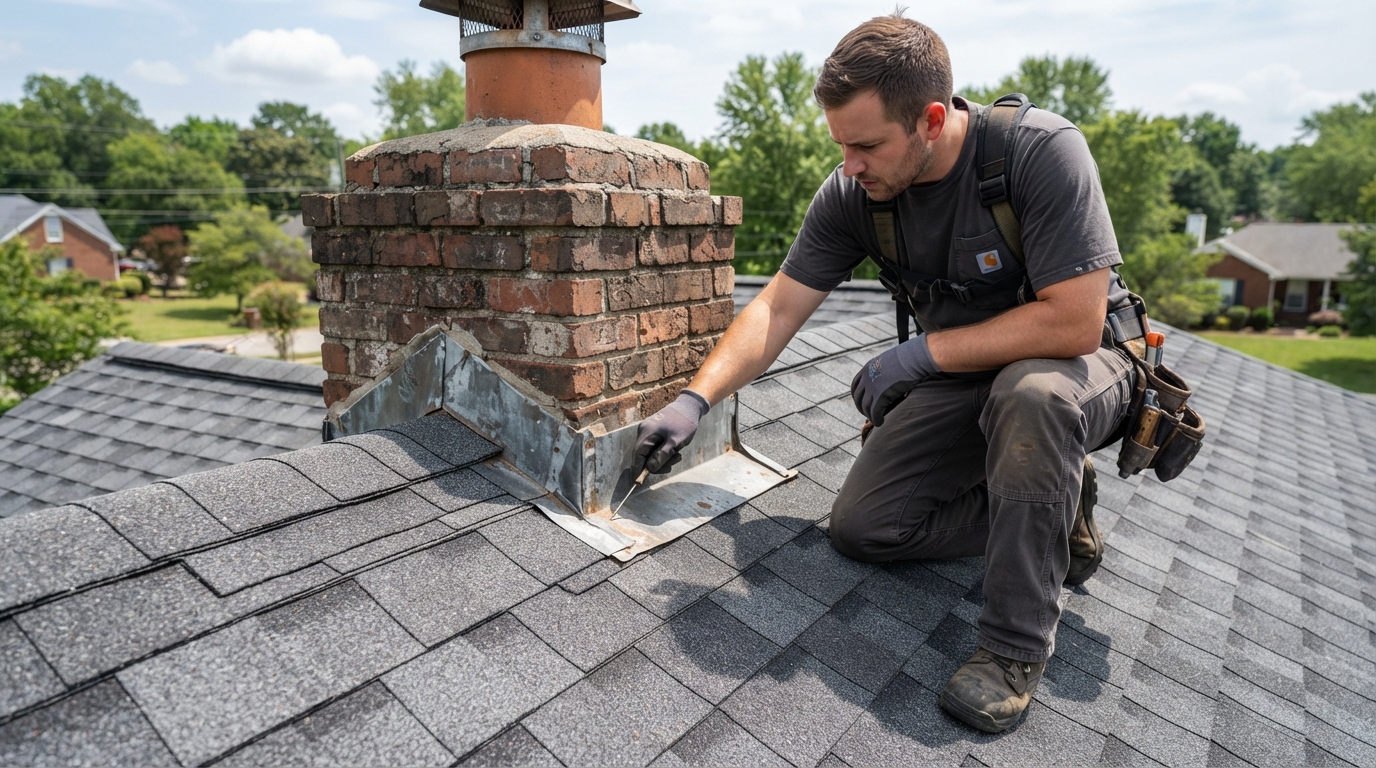
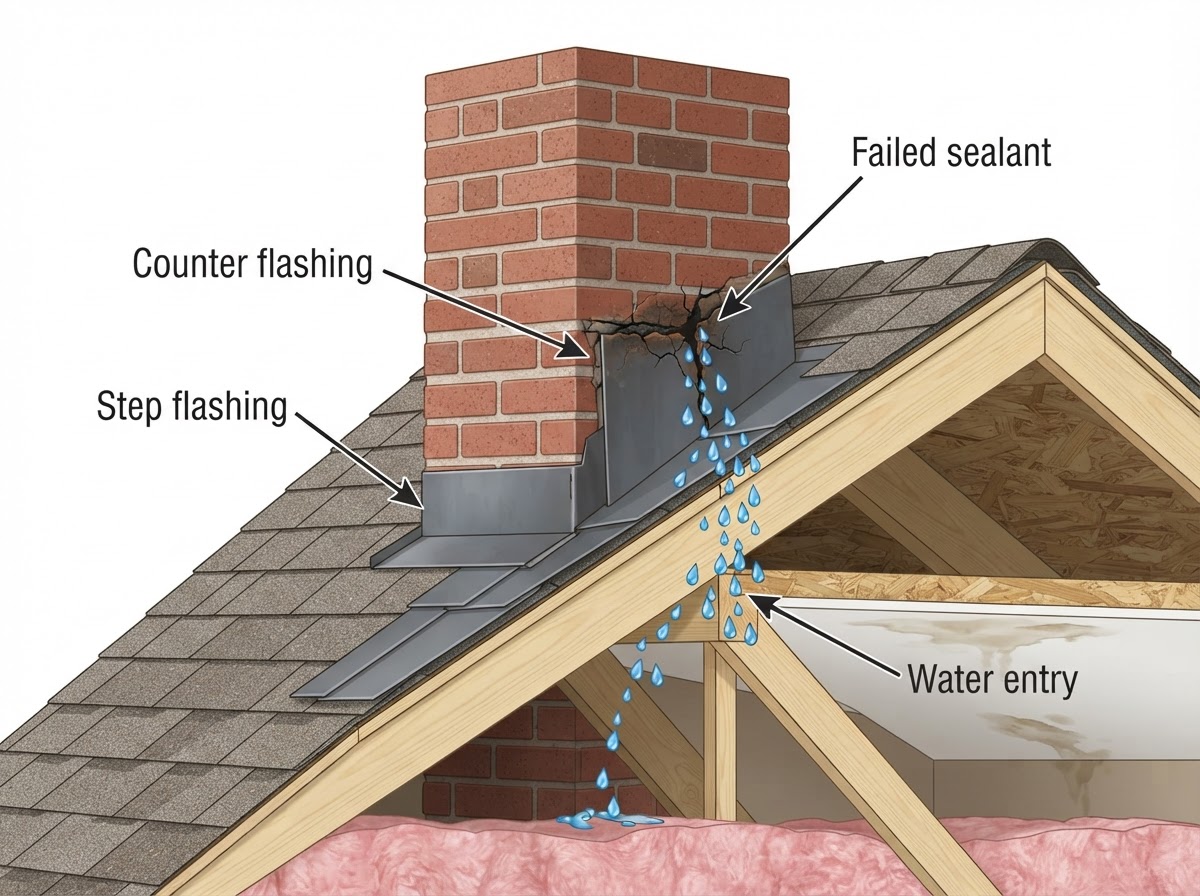
Flashing is the thin metal — usually aluminum, galvanized steel, or copper — that bridges the gap between the roof and anything that breaks its surface. Step flashing runs up the sides of walls and chimneys; counter flashing covers the top edge of the step flashing to keep water out of the joint. Skylights rely on a combination of curb flashing and sealant.
Flashing is the single most common leak source because it depends on sealant and overlapping metal that break down over time. Heat, UV exposure, and Middle Tennessee's wet-dry cycles dry out the caulking and rubber seals until they crack and pull away. A chimney or wall that looks perfectly intact from the ground can have failed flashing underneath that is quietly funneling water into the attic.
The telltale sign is a leak that shows up near a chimney, an exterior wall, or directly below a skylight — especially after wind-driven rain pushes water up under a flashing edge that has lost its seal.
2. Roof Valleys
A roof valley is the internal angle where two roof planes meet, and it is one of the highest-stress areas on any roof. All the water from both roof planes funnels through the valley, so the volume and velocity of runoff there is far greater than on a flat section.
Valleys fail for a few reasons: the underlayment or ice-and-water membrane beneath them can wear through, shingles can be cut too short or installed without proper overlap, and debris like leaves and twigs can collect in the valley and trap water against the shingles. Middle Tennessee's heavy spring and summer downpours put a lot of water through valleys in a short time, which is why valley leaks are common after storms even when the rest of the roof looks fine.
A valley leak often appears as a ceiling stain that runs along a diagonal line inside the home, roughly following the path of the valley above.
3. Plumbing Pipe Boots and Roof Penetrations
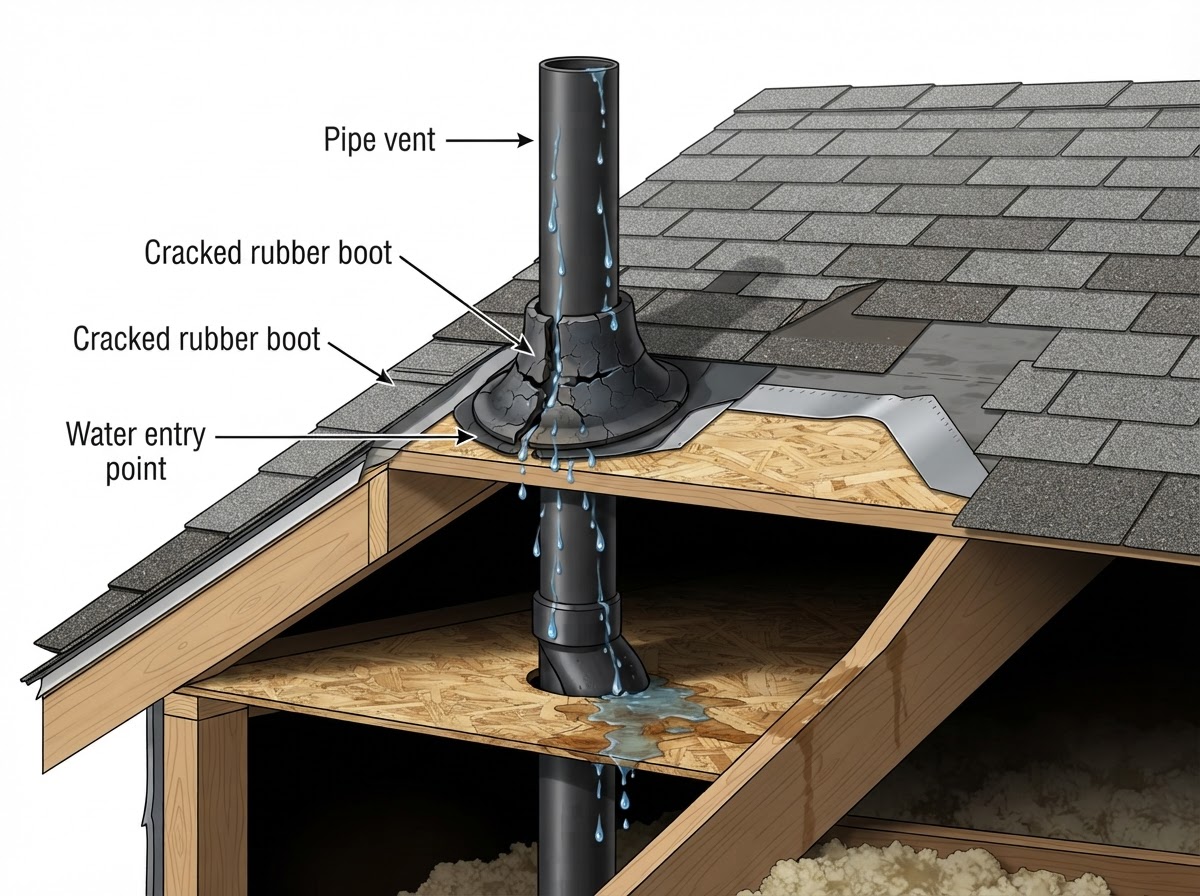
Every plumbing vent stack that passes through the roof is sealed with a pipe boot — a rubber or neoprene gasket that fits around the pipe and seals to the shingles. Plumbing vents, furnace and water-heater exhausts, bathroom fan vents, and electrical mast penetrations are all common leak entry points.
The rubber in a pipe boot has a limited life. After years of Middle Tennessee heat and UV exposure, the rubber cracks, splits, or pulls away from the pipe. Once that happens, water runs straight down the pipe and into the attic — and because the pipe often travels some distance before it exits the roof, the resulting ceiling stain can be far from the actual leak.
A cracked pipe boot is one of the most common and most easily repaired leak sources on an otherwise sound roof. The sign is a leak that appears during or right after rain, often near a bathroom or plumbing wall, on a roof that is otherwise in good shape.
4. Skylights and Skylight Curb Flashing
Skylights are a beautiful feature and a frequent leak source. The leak is rarely the glass itself — it is almost always the flashing and sealant around the skylight curb, where the frame meets the roof.
Skylight flashing faces the same sealant breakdown as chimney flashing, but it is more exposed. A skylight sits in the middle of the roof, takes direct sun and rain, and often has more complex flashing geometry than a chimney. Over time the curb seal dries out, the weep holes that drain condensation can clog, and water finds its way in around the frame.
If a leak appears directly below a skylight or along the drywall around the skylight shaft, the flashing and curb seal are the likely culprits — not the roof shingles around it.
5. Chimneys and Chimney Crowns
Chimneys are a leak source on two fronts. The flashing where the chimney meets the roof can fail, as covered above, but the chimney itself can also take on water. The mortar joints between bricks can deteriorate, and the concrete crown at the top of the chimney can crack and let water soak down into the structure.
When water enters through the chimney, it can travel down inside the chimney chase and show up as a stain on the ceiling or wall near the fireplace — which can look like a roof leak even when the roof is fine. This is one reason a professional inspection matters: the source of a 'roof leak' near a chimney is sometimes the chimney, not the roof.
6. Roof Vents, Exhaust Fans, and Satellite Mounts
Ridge vents, gable vents, bathroom and kitchen exhaust fans, and even old satellite dish mounts all create penetrations in the roof that need to be sealed. Each one is a potential leak point.
Exhaust fan vents in particular cause problems when the duct is not properly connected or when the vent hood is damaged or missing. A bathroom fan that vents into the attic instead of through the roof can cause moisture damage that looks like a roof leak. Satellite dish mounts left behind after an upgrade often have exposed lag bolts that were never properly flashed.
These smaller penetrations are easy to overlook, but they are a common reason a roof that otherwise looks good still leaks during heavy rain.
Why the Interior Drip Is Rarely the Leak Source
The single most important thing to understand about roof leaks is that water travels. Once it gets past the shingles, it runs down the underside of the roof decking, along a rafter, or across a vapor barrier until it finds a low point to drip from. The ceiling stain you see is the end of that journey, not the beginning.
This is why patching the shingles directly above a ceiling stain so often fails — the actual entry point may be several feet upslope. A professional roofer traces the water back to its source by looking at the attic, the decking, and the roof surface together. That is also why a free inspection is more useful than a guess: finding the true source is what makes a repair hold up instead of just hiding the stain temporarily.
When a Leak Means Repair vs. Replacement
A leak at one of these locations does not automatically mean you need a new roof. A single failed pipe boot, a section of cracked chimney flashing, or a few damaged valley shingles can often be repaired when the rest of the roof is still serviceable. Isolated leaks on a relatively newer roof usually point toward a targeted repair.
Replacement becomes more likely when leaks are recurring in multiple areas, when the flashing and penetrations are failing because the shingles themselves are at the end of their useful life, or when the decking beneath is soft or rotted. For help weighing that decision, see our Roof Repair vs. Replacement Guide and our guide on the signs you may need a roof replacement.
Common Leak Location Checklist for Homeowners
- Is the ceiling stain near a chimney, exterior wall, or skylight? (Think flashing.)
- Does the stain follow a diagonal line? (Think a roof valley.)
- Is the leak near a bathroom or plumbing wall? (Think a pipe boot.)
- Does the leak appear only during heavy, wind-driven rain? (Think flashing or seal failure.)
- Is the roof older, with shingles curling or losing granules? (Think broader replacement.)
- Have you had this same leak 'repaired' before without lasting? (The true source was never found.)
Have a question about your roof?
Terry personally answers the phone — no sales reps, no pressure.
Frequently Asked Questions
Straight answers to common questions from Middle Tennessee homeowners.
Where do roofs leak the most?
Roofs leak most often at penetrations and seams — flashing around chimneys, walls, and skylights; roof valleys where two roof planes meet; cracked plumbing pipe boots; and roof vents. Leaks rarely start in the middle of a flat field of shingles. Because water travels along the decking before dripping inside, the visible ceiling stain is usually not directly below the actual entry point.
Why does my roof leak near the chimney?
A leak near a chimney is usually caused by failed step or counter flashing — the metal and sealant that bridge the gap between the chimney and the roof. Over time, heat and UV exposure dry out the sealant until it cracks and pulls away. The chimney itself can also take on water through cracked mortar or a damaged crown, which can look like a roof leak even when the roof is fine.
Can a cracked pipe boot cause a roof leak?
Yes. A plumbing pipe boot is the rubber gasket that seals around a vent stack where it passes through the roof. The rubber cracks and splits after years of sun and heat exposure, and once it does, water runs straight down the pipe and into the attic. A cracked pipe boot is one of the most common and most easily repaired leak sources on an otherwise sound roof.
Why is the water stain on my ceiling not under the actual leak?
Water travels. Once it gets past the shingles, it runs down the underside of the roof decking or along a rafter until it finds a low point to drip from. The ceiling stain is the end of that trail, not the start of it. That is why patching the shingles directly above a stain often fails — the real entry point may be several feet upslope, which is why a professional inspection that traces the water back to its source is more reliable than a guess.
Does a roof leak mean I need a new roof?
Not necessarily. A single failed pipe boot, a section of cracked flashing, or a few damaged valley shingles can often be repaired when the rest of the roof is still serviceable. Replacement becomes more likely when leaks recur in multiple areas, when the shingles themselves are at the end of their useful life, or when the decking beneath is soft or rotted. An inspection tells you which situation you are in.
Does Terry Woodall Roofing offer free leak inspections in Middle Tennessee?
Yes. Terry Woodall Roofing offers free roof inspections across its Middle Tennessee service area, including Nashville, Franklin, Brentwood, Bellevue, Kingston Springs, Pegram, Fairview, Dickson, and Burns. Terry personally answers the business phone at (615) 300-6005. Serving Middle Tennessee since 1983, Terry traces a leak back to its true source so a repair holds up instead of just hiding the stain.
Terry Woodall Roofing Contractors
From the Terry Woodall Roofing Contractors Resource Center — serving Middle Tennessee homeowners since 1983
Terry Woodall Roofing Contractors brings over 40 years of hands-on roofing experience to Middle Tennessee homeowners. These resources are prepared to help homeowners understand roof maintenance, storm damage mitigation, and the insurance claims process so every home is protected. Founder Terry Woodall personally oversees the company's roofing work across Nashville, Franklin, Brentwood, and the surrounding communities.
Found this guide useful? Copy a ready-to-paste citation and attribute Terry Woodall Roofing as your source.
Terry Woodall. (2026-08-23). Where Do Roofs Leak Most? The 6 Most Common Roof Leak Locations for Middle Tennessee Homes. Terry Woodall Roofing. https://terrywoodallroofing.com/resources/common-roof-leak-locations-middle-tn
Related Roofing Services
If you suspect your roof needs attention, Terry Woodall offers straightforward evaluations across Middle Tennessee:
Where We Work in Middle Tennessee
Request a Call
Get straightforward answers directly from Terry.
Free roof inspection — and free estimates on any recommended work.
This form is for Middle Tennessee homeowners requesting roofing help only. Marketing, sales, and vendor solicitations are not accepted and will be discarded.
Need an Honest Roof Inspection?
Speak directly with Terry Woodall today. No pushy sales representatives, just a local reputation built since 1983.
Call (615) 300-6005Text TerryHave a ceiling stain and want to know where the water is really getting in? Terry Woodall Roofing provides free leak inspections across Middle Tennessee — serving homeowners since 1983. Call (615) 300-6005 to speak directly with Terry and find the true source of the leak.