
Why Are My Roofing Estimates So Different? How to Compare Roof Replacement Quotes
Got roofing estimates that are thousands apart? Learn why roof replacement quotes differ and how Middle Tennessee homeowners can compare bids fairly before hiring.
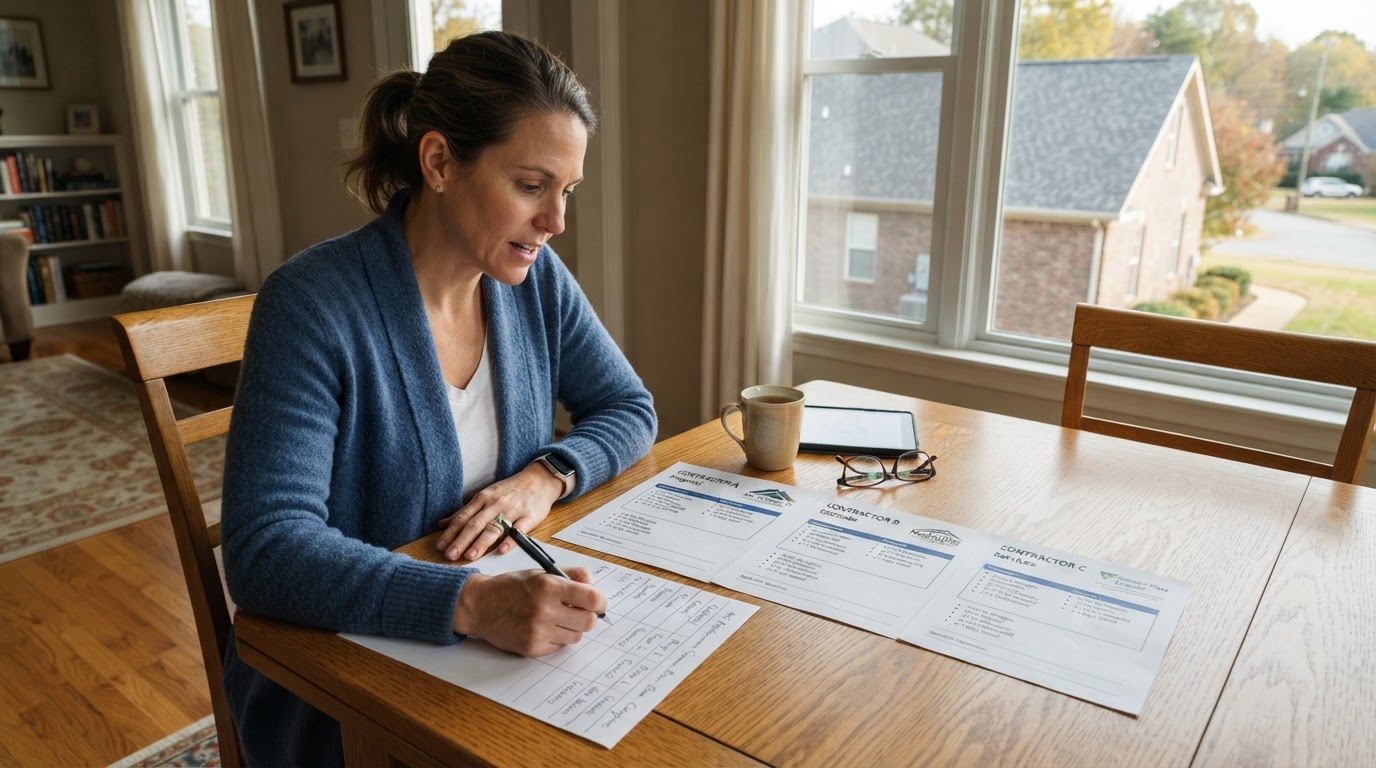
- 1.Why Can Roof Replacement Estimates Be So Different?
- 2.First, Make Sure You Understand Each Estimate
- 3.1. Find Out Whether the Contractors Are Quoting the Same Scope
- 4.2. Compare the Actual Roofing Products, Not Just Broad Labels
- 5.3. Separate Known Work From Allowances and Unknown Conditions
- 6.4. Ask Why Flashing or Ventilation Recommendations Differ
- 7.5. Compare How Each Contractor Handles Hidden Repairs
- 8.6. Look Beyond the Length of the Warranty
- 9.7. Compare the Contractor Behind the Quote
- 10.8. Ask Who You Will Actually Be Working With
- 11.9. Do Not Assume the Cheapest Quote Is the Best Deal
- 12.10. The Highest Quote Is Not Automatically the Best One Either
- 13.11. Normalize the Quotes Before You Compare Price
- 14.A Practical Example: Three Different Quotes for the Same Roof
- 15.What If Two Contractors Recommend Completely Different Solutions?
- 16.What If One Contractor Will Match Another Roofer's Price?
- 17.What If an Estimate Is Much Lower Than All the Others?
- 18.What If Two Quotes Are Nearly Identical?
- 19.Questions to Ask When Roofing Quotes Don't Match
- 20.A Simple Rule for Comparing Roofing Estimates
Roofing estimates can differ because contractors may propose different materials, scopes of work, assumptions, allowances, warranty options, or additional work, and they can have different labor and operating costs. Before treating the price spread as meaningful, determine whether the contractors are actually quoting substantially the same project. Tennessee consumer guidance recommends getting at least three estimates and making sure each contractor bids on the same work, while the National Roofing Contractors Association cautions against making price the only criterion. Terry Woodall Roofing Contractors offers free roof inspections across Middle Tennessee — call (615) 300-6005.
Key Takeaways for Middle Tennessee Homeowners
- Two or three roof replacement estimates for the same house can be thousands of dollars apart without one contractor overcharging or another offering a bargain — the quotes may describe different work, materials, assumptions, warranty protection, or contractor responsibility.
- The single most useful question when bids are far apart is whether the contractors are actually proposing the same job: a lower total can simply mean less work is being proposed, and a higher total is not automatically more complete.
- Tennessee consumer guidance recommends getting at least three estimates and making sure each contractor bids on the same work, while the National Roofing Contractors Association cautions against making price the only criterion.
- Before comparing bottom-line totals, normalize the quotes by aligning the roofing product, scope, allowances, hidden-repair procedures, warranties, and contractor qualifications.
- Terry Woodall Roofing Contractors has served Middle Tennessee since 1983, is licensed and bonded, and offers free roof inspections. Terry personally answers the business phone at (615) 300-6005.
If two or three roof replacement estimates for the same house are thousands of dollars apart, it does not automatically mean one contractor is overcharging or another is offering a bargain. The quotes may describe different work, different materials, different assumptions, different warranty protection, or different levels of contractor responsibility.
The best way to compare roofing estimates is to make them as close to an apples-to-apples comparison as possible before you compare the totals. That means identifying what is actually different, asking each contractor to clarify unclear items, and then deciding which proposal gives you the best combination of appropriate scope, clear terms, contractor confidence, and price.
Tennessee consumer guidance recommends getting at least three estimates and making sure each contractor bids on the same work. The National Roofing Contractors Association also cautions homeowners against making price the only criterion when selecting a roofing contractor. Here is how to put that advice into practice.
Why Can Roof Replacement Estimates Be So Different?
Two roofing contractors can inspect the same house and arrive at different estimates because they may not be proposing exactly the same project. The difference can come from several places: different roofing products or material levels; different interpretations of what should be replaced; different assumptions about existing components; different treatment of possible decking repairs; different ventilation or flashing recommendations; different warranty offerings; different exclusions or allowances; different labor, supervision, and business operating structures; different approaches to cleanup, property protection, or project management; and different profit and overhead requirements.
Sometimes the difference is meaningful. Sometimes it is mostly a difference in price. Your job as the homeowner is not to guess which is which. Your job is to make each contractor explain enough of the proposal that you can compare the same job as closely as possible.
First, Make Sure You Understand Each Estimate
Before trying to decide why two bids are different, make sure you can understand what each contractor is proposing. If one proposal is detailed and another is vague, you do not yet have enough information for a fair comparison.
Our Roof Replacement Estimate Checklist explains what a replacement estimate should address, including the scope, roofing materials, tear-off, decking, flashing, ventilation, warranties, payment terms, and additional-work procedures. Use that resource first if you are unsure whether the proposals in front of you are complete enough to evaluate.
This article starts with the next question: Once you understand the estimates, why are they different — and which differences actually matter?
1. Find Out Whether the Contractors Are Quoting the Same Scope
The single most useful question when bids are far apart is: Are these contractors actually proposing the same job? One roofer may be proposing replacement of certain components while another plans to reuse them. One may include corrective work that another does not believe is needed. One may have included an item in the base proposal while another treats it as an additional charge.
A lower total does not necessarily mean lower quality. It can simply mean less work is being proposed. Likewise, a higher proposal is not automatically more complete or better. Ask each contractor to explain the major differences you see.
For example: "This proposal includes new flashing and the other one doesn't. Why?" "One contractor recommended ventilation changes and the other did not. What did you see that led to your recommendation?" "Does this price assume the existing component can be reused?" "Is this work included in your base price or would it become an additional charge?"
The goal is not to force every roofer to make an identical recommendation. Different professionals can reach different conclusions. The goal is to understand why their scopes differ.
2. Compare the Actual Roofing Products, Not Just Broad Labels
Two estimates can both say "architectural shingles" while proposing different products or roofing-system configurations. When the material choices differ, ask the contractors to identify exactly what they are proposing and explain why.
Relevant differences can include: shingle manufacturer and product line; product tier; impact-resistance or other product features; underlayment or accessory system; manufacturer warranty option; and required companion components. You do not need to become a roofing-material expert to compare bids. You simply need to know whether a price difference partly reflects a different product.
If one contractor is proposing a different shingle or roofing-system level than another, decide whether you actually want that upgrade before treating the higher price as a negative. Our separate Choosing the Right Asphalt Shingles for Your Tennessee Home guide can help if the disagreement between bids is primarily about which roofing product to choose.
3. Separate Known Work From Allowances and Unknown Conditions
A roofing estimate is prepared before the old roof has been completely removed. That means some conditions can remain hidden. Roof decking is a common example. A contractor may know that damaged decking is possible but may not know the full extent until tear-off.
Different contractors can handle those unknowns differently in their proposals. One may include an allowance. Another may give a unit price for additional decking if needed. Another may exclude unexpected decking repairs from the base total. Those approaches can make the initial totals look different even before the contractors perform the work.
When comparing quotes, ask: Does this number represent the same known work, or is one contractor including an allowance that another contractor has left outside the base price? You want to know which differences exist because the contractors are proposing different roofs and which exist simply because they account for uncertainty differently.
4. Ask Why Flashing or Ventilation Recommendations Differ
Sometimes one contractor recommends replacing or changing something another contractor believes can remain. That does not automatically prove either contractor is wrong. Flashing and ventilation are good examples because recommendations depend on the condition and configuration of the existing roof.
If the bids disagree, ask each contractor to explain the reasoning behind the recommendation. Useful questions include: What did you observe? Why do you believe this work is necessary? What happens if it is not done? Is the existing component serviceable? Is your recommendation related to the roofing product or warranty being proposed?
This is more useful than simply asking one contractor to match another contractor's price. A price can be changed. The condition of the roof cannot.
5. Compare How Each Contractor Handles Hidden Repairs
Two estimates may appear close until you read what happens when unexpected conditions are discovered. This can materially affect what the project ultimately costs and how smoothly decisions are made during installation.
You do not need a long list of every possible hidden condition. Our Roof Replacement Estimate Checklist explains how additional work should be addressed in the proposal. For comparison purposes, focus on three things: How does each contractor identify and document unexpected work? How is the price of that work determined? How is homeowner approval handled?
If one bid has a very low initial total but leaves major unknowns undefined, do not assume its final cost will necessarily remain lower. Likewise, do not assume a contractor who clearly accounts for possible additional work is predicting that all of it will be necessary. The comparison should distinguish base scope from conditional work.
6. Look Beyond the Length of the Warranty
A longer warranty on paper does not automatically make one roofing quote better. First determine what type of warranty you are comparing. A replacement project may involve a manufacturer warranty associated with roofing products and a separate workmanship warranty from the contractor.
Two bids can differ because they use different products, warranty tiers, or workmanship terms. Ask: Is this a manufacturer warranty or a contractor workmanship warranty? Who is responsible if there is a problem? What exactly does the warranty cover? Are there important exclusions or maintenance requirements? Are specific installation requirements tied to the manufacturer coverage?
The National Roofing Contractors Association recommends carefully reading the warranty and understanding provisions that could void it. Our Roofing Warranties Explained resource goes deeper into warranty differences if this is a major factor in your decision. When comparing quotes, the important question is not simply "Which one has the biggest warranty number?" It is: "What protection am I actually receiving with each proposal?"
7. Compare the Contractor Behind the Quote
A roof replacement estimate is not only a price for materials. You are also choosing the company responsible for installing the system, communicating with you, protecting the property, and standing behind the work.
The National Roofing Contractors Association recommends researching a contractor's permanent place of business, appropriate business licensing, liability insurance and workers' compensation coverage, references, and track record. It also recommends asking who will oversee the project and how the contractor handles supervision and quality control. Those are meaningful comparison points.
For each contractor you are seriously considering, verify the credentials that apply to the project rather than assuming the lowest or highest price tells you anything about contractor reliability. Tennessee licensing requirements can depend on the project and contractor role, so homeowners should use the Tennessee Board for Licensing Contractors' official resources when verifying current licensing requirements or status. Terry Woodall Roofing Contractors is licensed and bonded and has served Middle Tennessee since 1983. For a broader contractor-selection process, see How to Choose a Roofing Contractor in Middle Tennessee.
8. Ask Who You Will Actually Be Working With
Homeowners often spend most of their time comparing the physical roof and very little time comparing the experience of getting the project completed. Ask who will communicate with you from the estimate through installation.
Questions can include: Who answers my questions before the project? Who will oversee the job? Who do I contact if something unexpected happens? How are changes communicated? Who follows up if there is a problem afterward? The National Roofing Contractors Association specifically recommends asking contractors about project supervision and quality-control procedures.
This is also an area where Terry Woodall Roofing's business model is different from many larger sales organizations: Terry personally answers the business phone, so homeowners work directly with the owner rather than being routed only through a large sales operation. That does not mean a larger company is automatically a poor choice. It means the communication model is another legitimate factor to compare along with the written proposal.
9. Do Not Assume the Cheapest Quote Is the Best Deal
The National Roofing Contractors Association advises homeowners to maintain a healthy skepticism about the lowest bid and emphasizes that price is only one criterion in selecting a roofing contractor. That does not mean the lowest estimate is automatically wrong. A contractor can legitimately be less expensive.
The problem comes from treating the lowest number as the winner before determining whether the contractor is proposing comparable work. If the lower bid still provides the roofing system you want, an appropriate scope for the roof's condition, clear terms, acceptable warranty protection, proper contractor qualifications, and a process you are comfortable with, then the lower price may represent good value.
But if the number is lower because important work is excluded, materials differ, or responsibilities are unclear, you are not comparing the same purchase.
10. The Highest Quote Is Not Automatically the Best One Either
Homeowners sometimes react to large quote differences by assuming the expensive contractor must be doing better work. Price alone cannot establish that either. A higher estimate deserves the same scrutiny as a lower one.
Ask the contractor to explain what the additional money buys. Is there a different material? Additional work? A warranty upgrade? A different installation specification? Work that another contractor believes is unnecessary? An allowance included in this bid but excluded from another? Simply a higher price for substantially comparable work?
A contractor should be able to explain the recommendation in terms a homeowner can understand. You do not need to accept an upgrade or broader scope simply because it appears in the most expensive quote.
11. Normalize the Quotes Before You Compare Price
Once you understand the differences, create a simple side-by-side comparison. You are not trying to rewrite the estimates. You are trying to put the important differences into the same categories.
For example, compare each contractor on: the main roofing product (same or different); base scope (comparable or different); optional or additional work (clear or unclear); hidden-repair approach (clear or unclear); warranty protection (comparable or different); contractor credentials checked (yes or no); project communication (clear or unclear); and total after known scope is aligned.
Do not fill blanks with assumptions. If an important item is unclear, ask the contractor. Only after the known scope is reasonably aligned should you place much weight on the difference in total price.
A Practical Example: Three Different Quotes for the Same Roof
Imagine that three contractors inspect the same Middle Tennessee home. The homeowner initially sees Contractor A with the lowest total, Contractor B with the middle total, and Contractor C with the highest total. At first, it looks like a simple pricing decision.
After asking questions, the homeowner discovers: Contractor A proposes one material and plans to reuse a component that appears serviceable. Contractor B proposes a different roofing product and includes additional work in the base scope. Contractor C proposes the same basic replacement as Contractor B but also includes an optional upgrade.
Now the original question — "Why is one roofer so much more expensive?" — has several answers. Part of the difference comes from product choice. Part comes from scope. Part comes from an upgrade. Once those differences are identified, the homeowner can ask each contractor to price the version of the project the homeowner actually wants. That creates a much more useful comparison.
The numbers in this example are intentionally omitted because this guide is not designed to establish what a Middle Tennessee roof replacement should cost. Our separate Roof Replacement Cost Guide explains the factors that determine overall replacement pricing.
What If Two Contractors Recommend Completely Different Solutions?
Sometimes the disagreement is bigger than price. One contractor may recommend substantial additional work while another says it is unnecessary. In other cases, one roofer may recommend replacement while another believes the roof can still be repaired.
Do not resolve a major disagreement by choosing whichever answer is cheaper or more expensive. Ask each contractor to explain what physical condition led to the recommendation. If you are still uncertain, getting another roof inspection can be reasonable before committing to a major project.
Terry Woodall Roofing's approach is to inspect the actual condition of the roof and recommend the work it reasonably needs. Replacement should not be treated as automatic when a repair can reasonably solve the problem. If your real question is whether you need replacement at all, our Roof Repair vs. Replacement Guide is the better next resource.
What If One Contractor Will Match Another Roofer's Price?
A price match does not automatically make two proposals equivalent. Before accepting a revised number, ask whether anything else changed. For example: Did the scope change? Did the roofing product change? Was an upgrade removed? Did warranty coverage change? Is the contractor simply reducing the price while keeping the same proposal?
The important comparison is still the work you will receive, not just the revised total. Get any changes reflected in writing. Tennessee consumer guidance advises homeowners to use written contracts rather than verbal agreements and to put changes in writing.
What If an Estimate Is Much Lower Than All the Others?
A significantly lower bid deserves questions, not an automatic rejection. Start by checking whether it covers substantially the same project. Ask the contractor to explain any differences in proposed work, materials, optional items, warranty protection, hidden-repair procedures, and contractor responsibilities.
Also verify the contractor independently. The National Roofing Contractors Association recommends checking business information, applicable licensing, liability and workers' compensation coverage, references, and track record. If the scope is comparable, the contractor checks out, and the lower price has a reasonable explanation, it may be a legitimate offer. If important answers remain vague, the low number itself is not enough reason to sign.
What If Two Quotes Are Nearly Identical?
When the scope and price are close, the decision may come down to factors beyond the total. Consider: Which contractor gave the clearest explanation of the roof's condition? Which proposal is easiest to understand? Who answered questions directly? Who will oversee the project? Which warranty terms do you understand and prefer? Which contractor's track record have you verified? Who has a clear process if conditions change after tear-off? Who do you trust to tell you when work is — and is not — necessary?
Roof replacement is a construction project, not just a commodity purchase. The relationship with the contractor matters after the estimate is signed.
Questions to Ask When Roofing Quotes Don't Match
You do not need to interrogate each roofer line by line. Focus on the differences. Ask: What are you proposing that the other contractor may not be? Are we comparing the same roofing product? Is any part of your price an allowance or optional upgrade? What existing components are you planning to reuse? Why are you recommending this additional work? How do you handle unexpected repairs after tear-off? What warranty differences should I understand? Who will oversee and communicate about the project? What could legitimately change your quoted price? If I wanted the same scope as the other proposal, what would change?
A good comparison conversation should make the differences clearer — not pressure you into making a faster decision.
A Simple Rule for Comparing Roofing Estimates
Use this order: First, understand each proposal. If you are not sure what an estimate includes, start with our Roof Replacement Estimate Checklist. Second, identify the differences. Separate material, scope, warranty, allowance, and contractor differences. Third, ask why those differences exist. Do not assume more work is better or less work is worse.
Fourth, align the project you actually want. Make the proposals as comparable as practical. Fifth, verify the contractor. Check credentials, insurance, track record, and who will supervise the project. Sixth, compare the totals. Price becomes much more useful once you understand what each price buys. That is the difference between shopping for the lowest number and comparing roofing proposals intelligently.
Questions to Ask When Roofing Quotes Don't Match
- What are you proposing that the other contractor may not be?
- Are we comparing the same roofing product?
- Is any part of your price an allowance or optional upgrade?
- What existing components are you planning to reuse?
- Why are you recommending this additional work?
- How do you handle unexpected repairs after tear-off?
- What warranty differences should I understand?
- Who will oversee and communicate about the project?
- What could legitimately change your quoted price?
- If I wanted the same scope as the other proposal, what would change?
Have a question about your roof?
Terry personally answers the phone — no sales reps, no pressure.
Frequently Asked Questions
Straight answers to common questions from Middle Tennessee homeowners.
Why are roofing estimates so different for the same house?
Roofing estimates can differ because contractors may propose different materials, scopes of work, assumptions, allowances, warranty options, or additional work. They can also have different labor and operating costs. Before treating the price spread as meaningful, determine whether the contractors are actually quoting substantially the same project.
How should I compare two roof replacement estimates?
First make sure you understand what each proposal includes. Then compare the main roofing product, scope, assumptions, optional work, hidden-repair procedures, warranties, and contractor qualifications. Ask contractors to clarify differences before comparing the bottom-line totals. For a detailed explanation of what should appear in the proposal itself, use our Roof Replacement Estimate Checklist.
Is the cheapest roofing quote usually the worst?
No. A lower roofing estimate is not automatically a poor choice. The National Roofing Contractors Association advises homeowners not to make price the only criterion, but a lower quote can still be legitimate. The important question is whether it represents comparable work from a properly qualified contractor with clear terms.
Is the most expensive roofing quote usually the best?
No. A higher price does not prove that a contractor is proposing better work. Ask what the additional cost buys. It may reflect different materials or additional work, but it may also be an optional upgrade or simply a higher price for a comparable project.
How many roofing estimates should I get?
Tennessee consumer guidance recommends getting at least three estimates and making sure each contractor bids on the same work. Three proposals can give you useful comparison points, but the quality and clarity of the estimates matter more than simply collecting a large number of quotes.
Should I show one roofer another contractor's estimate?
You can ask contractors to explain differences between proposals, but the more important goal is understanding their own recommendation. Instead of asking only, "Can you beat this price?" ask why the proposed scope, material, or recommendation differs. That gives you more useful information about the roof and what the contractor intends to do.
Why does one roofing quote include work another contractor says I don't need?
Contractors can interpret existing conditions differently or make different recommendations. Ask both contractors what they observed and why they reached their conclusions. If the disagreement involves substantial work or whether the roof needs replacement at all, another inspection may help before you make the decision.
Can a roofing estimate change after work starts?
Some conditions can remain hidden until the old roofing is removed, so additional work may become necessary. Before signing, understand how the contractor handles, prices, and obtains approval for changes. For more detail about how additional work should be addressed in the proposal, see our Roof Replacement Estimate Checklist.
Why shouldn't I just compare roofing quotes by price per square?
A single unit price can hide differences in materials, scope, warranties, assumptions, and included work. If the proposals are not for substantially the same job, comparing one unit price does not make them equivalent. For information about the factors that determine the overall cost of replacing a Middle Tennessee roof, see our separate Roof Replacement Cost Guide.
Terry Woodall Roofing Contractors
From the Terry Woodall Roofing Contractors Resource Center — serving Middle Tennessee homeowners since 1983
Terry Woodall Roofing Contractors brings over 40 years of hands-on roofing experience to Middle Tennessee homeowners. These resources are prepared to help homeowners understand roof maintenance, storm damage mitigation, and the insurance claims process so every home is protected. Founder Terry Woodall personally oversees the company's roofing work across Nashville, Franklin, Brentwood, and the surrounding communities.
This guide relies on authoritative industry standards, building code regulations, and verifiable research from recognized organizations:
Found this guide useful? Copy a ready-to-paste citation and attribute Terry Woodall Roofing as your source.
Terry Woodall. (2026-09-09). Why Are My Roofing Estimates So Different? How to Compare Roof Replacement Quotes. Terry Woodall Roofing. https://terrywoodallroofing.com/resources/why-roofing-estimates-differ-compare-quotes
Related Roofing Services
If you suspect your roof needs attention, Terry Woodall offers straightforward evaluations across Middle Tennessee:
Where We Work in Middle Tennessee
Keep Reading
Request a Call
Get straightforward answers directly from Terry.
Free roof inspection — and free estimates on any recommended work.
This form is for Middle Tennessee homeowners requesting roofing help only. Marketing, sales, and vendor solicitations are not accepted and will be discarded.
Need an Honest Roof Inspection?
Speak directly with Terry Woodall today. No pushy sales representatives, just a local reputation built since 1983.
Call (615) 300-6005Text TerryIf you have two or three roof replacement estimates and the recommendations do not agree, the first step is understanding what your roof actually needs. Terry Woodall Roofing Contractors has served Middle Tennessee since 1983, is licensed and bonded, and offers [[free roof inspections|/roof-inspection]] within its service area. Terry personally answers the business phone, so homeowners can discuss the roof directly with him rather than being routed through a large sales organization. The company's approach is inspection-first: recommend the work the roof reasonably needs, including a repair when a repair can solve the problem rather than automatically treating replacement as the answer. Call Terry directly at (615) 300-6005 or request a free roof inspection.