
The Complete Roof Ventilation & Attic Guide for Middle Tennessee Homes (2026)
How proper roof and attic ventilation protects your shingles, lowers cooling costs, and prevents moisture damage in Middle Tennessee's humid climate. Learn intake vs. exhaust vents, ridge vents, soffit vents, and how to tell if your attic is poorly vented — a researched guide from Terry Woodall Roofing.
- 1.Why Roof Ventilation Matters in Middle Tennessee
- 2.How a Balanced Ventilation System Works
- 3.Intake Vents: Soffit and Undereave Vents
- 4.Exhaust Vents: Ridge, Box, and Powered Vents
- 5.How Much Ventilation Does an Attic Need?
- 6.Signs Your Attic Is Poorly Vented
- 7.Ventilation and Shingle Warranty
- 8.Ventilation, Insulation, and Energy Costs
- 9.Common Ventilation Mistakes to Avoid
Roof ventilation works by drawing cool, dry air in through intake vents at the soffits (under the eaves) and letting hot, moist air escape through exhaust vents at or near the ridge. This continuous airflow keeps the attic temperature closer to outside air, removes moisture, and protects the roof deck and shingles. A properly vented attic needs balanced intake and exhaust — roughly 1 square foot of net free vent area per 300 square feet of attic floor space when a vapor barrier is present. Signs of poor ventilation include a very hot attic in summer, moisture or frost on roof nails in winter, curling shingles, mold on the underside of the deck, and high cooling bills. Terry Woodall Roofing evaluates attic ventilation on every inspection across Middle Tennessee — call (615) 300-6005.
Key Takeaways for Middle Tennessee Homeowners
- A balanced roof ventilation system needs both intake vents (low, at the soffits) and exhaust vents (high, at the ridge) to create continuous airflow — one without the other does not work.
- Poor attic ventilation is one of the leading causes of premature asphalt shingle failure, because a superheated roof deck bakes the shingles from underneath and breaks down the asphalt.
- Middle Tennessee's humid climate makes ventilation even more critical — trapped moisture in a poorly vented attic leads to mold, wood rot, and deck softening that can require expensive repairs during a roof replacement.
- The generally referenced attic ventilation ratio is 1 square foot of net free vent area per 300 square feet of attic floor space when a vapor barrier is present, and 1 per 150 without one — but exact requirements depend on roof design and local code.
- Signs of poor ventilation include a dangerously hot attic in summer, visible moisture or frost on nails in winter, curling or cupping shingles, and high cooling bills — all of which a free inspection can evaluate.
- Terry Woodall Roofing evaluates attic ventilation on every inspection across Middle Tennessee and has since 1983. Call (615) 300-6005 to speak directly with Terry.
Roof ventilation is the most misunderstood part of a roofing system. Most homeowners think a roof is just shingles and a deck — but the airspace between the deck and your ceiling (the attic) is a working part of the roof, and how air moves through it determines how long your shingles last, how much you spend on cooling, and whether hidden moisture is quietly rotting the wood that holds your roof up.
In Middle Tennessee, where summer attic temperatures can soar well above 130°F and humidity stays high for months, ventilation is not optional — it is the difference between a roof that lasts 25 years and one that fails at 15. This guide explains how roof ventilation works, the types of vents you'll see on Middle Tennessee homes, how to tell if your attic is poorly vented, and what to do about it. For the related topic of moving water off the roof edge, see our Complete Gutter Guide.
Common Roof Vent Types Compared
Use this as a general guide, not a hard rule. Every situation still needs an in-person inspection to weigh the factors together.
| Situation | Repair may make sense | Replacement may make sense |
|---|---|---|
| Ridge vent (exhaust, at roof peak) | Low-profile, runs along the ridge, blends into the roofline — the most common modern exhaust vent when paired with soffit intake. | Best paired with continuous soffit vents for balanced airflow; avoid mixing with box vents on the same roof. |
| Soffit vents (intake, under eaves) | Provide the cool air intake that makes the whole system work — without intake, exhaust vents pull nothing. | Undereave vents or continuous soffit vents should be unblocked by insulation; blocked soffits are a top cause of failure. |
| Box / static vents (exhaust, individual) | Simple, no moving parts, inexpensive — but less even airflow than a ridge vent and more visible on the roof. | Workable on simpler roofs; do not combine with a ridge vent on the same attic space (short-circuits airflow). |
| Powered / turbine vents (exhaust, active) | Move more air than static vents, but turbine vents rely on wind and powered vents use electricity and can fail mechanically. | Can help on problem attics but must still be matched to adequate intake; overpowered exhaust without intake can pull conditioned air from the house. |
Why Roof Ventilation Matters in Middle Tennessee
Ventilation serves two jobs: it controls attic temperature and it controls moisture. In a Middle Tennessee summer, the sun bakes the shingles and the roof deck radiates that heat into the attic. Without airflow to carry it away, attic temperatures can climb 40–50°F above outside air. That trapped heat bakes the shingles from the underside, accelerating the breakdown of the asphalt that holds the granules in place — which is one of the reasons poorly vented roofs lose shingle life far faster than well-vented ones.
Moisture is the second, slower threat. Middle Tennessee's humid air carries a lot of water vapor, and everyday household activity — showers, cooking, laundry — adds more. In a poorly vented attic, that moisture condenses on the cool underside of the roof deck on winter nights, wetting the wood night after night. Over years, that cycle rots the deck, grows mold, and rusts the nails holding your shingles on. The Insurance Institute for Business & Home Safety (IBHS) identifies proper attic ventilation as a key factor in reducing moisture-related roof deck damage and prolonging roofing service life.
How a Balanced Ventilation System Works
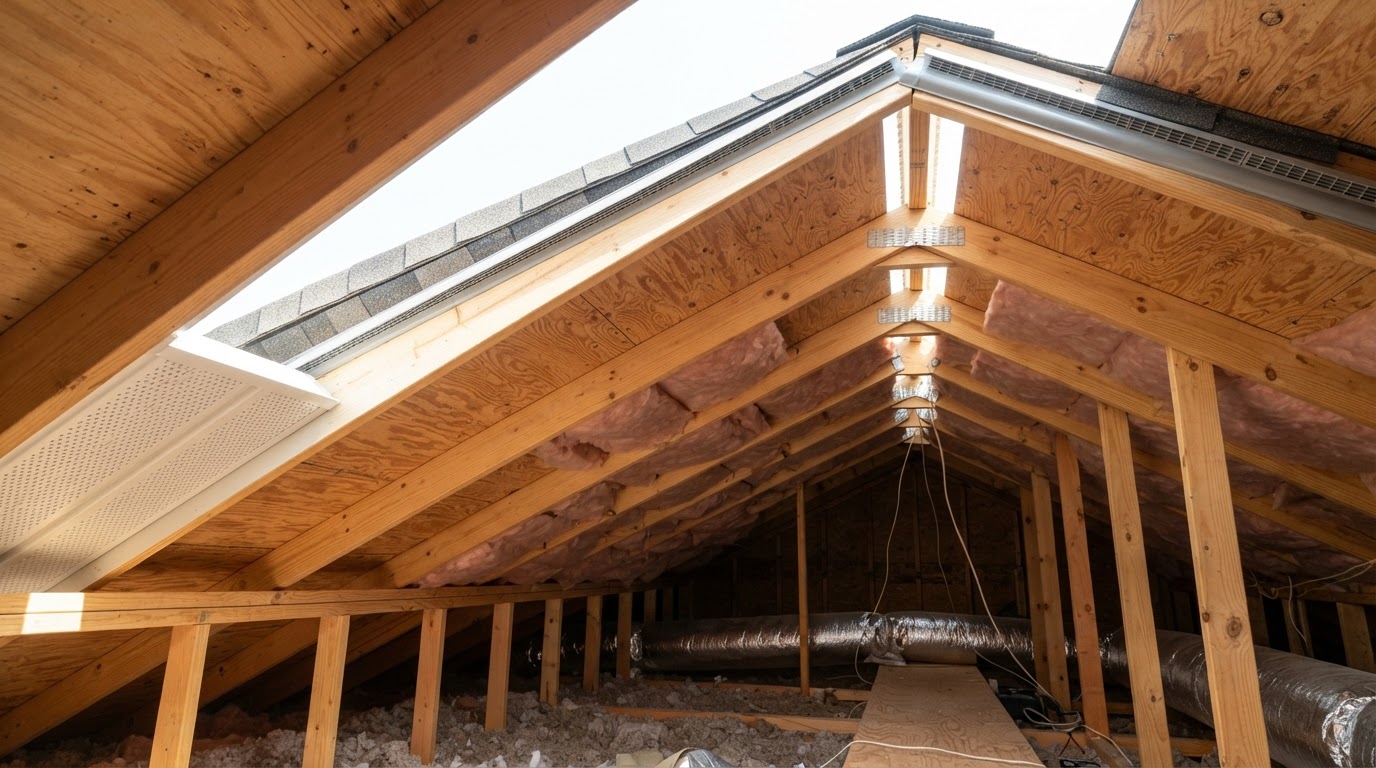
A ventilation system only works when air can enter low and exit high. Intake vents — almost always at the soffits under the eaves — let cool, dry air in at the bottom. Exhaust vents — at or near the ridge (the roof peak) — let hot, moist air out at the top. As the attic air warms, it rises and exits the exhaust vents, which pulls fresh air in through the intake vents. That continuous loop is what keeps the attic temperature and moisture in check.
The critical rule is balance. Exhaust without intake does nothing — the exhaust vent has no air to pull. Intake without exhaust traps the hot air at the peak. And mixing different exhaust types on the same attic space (for example, a ridge vent plus box vents) can short-circuit the system, with the lower vent acting as an intake and leaving the upper roof unvented. A properly designed system matches total exhaust capacity to total intake capacity, with slightly more intake than exhaust so the exhaust vents never starve.
Intake Vents: Soffit and Undereave Vents
Soffit vents are the workhorse of intake ventilation. They sit under the eaves, where the roof overhangs the exterior wall, and they are usually either individual screened vents or a continuous perforated strip along the soffit. Their job is simple: let air in. But they only work if they are not blocked — and the most common blockage is attic insulation pushed all the way out to the roof edge, covering the soffit from the inside.
If your home has soffit vents but the attic insulation has migrated over them, air cannot enter and the entire ventilation system stalls. Baffles (plastic or foam channels stapled to the underside of the deck between rafters) hold the insulation back and keep the air path from the soffit to the ridge open. Checking for blocked soffits is one of the first things a thorough inspection looks for, because it is a cheap fix with a big payoff.
Exhaust Vents: Ridge, Box, and Powered Vents
The ridge vent is the most common exhaust vent on modern Middle Tennessee roofs. It is a low-profile strip cut into the ridge (the peak) and covered with shingle material so it nearly disappears into the roofline. Because it runs the full length of the ridge, it exhausts hot air evenly across the whole roof rather than in one spot. Ridge vents have no moving parts, so nothing breaks, and they are the preferred exhaust when paired with continuous soffit intake.
Box vents (also called static or turtle vents) are individual roof-mounted exhaust vents. They are simpler and cheaper, but each one only vents a small area, so a roof needs several, and they are more visible. Powered attic vents use a fan to force air out; they move more air than passive vents but use electricity, can fail mechanically, and — critically — if intake is inadequate they can pull conditioned air out of the living space below, increasing rather than decreasing energy costs. Turbine vents spin with wind to draw air out and sit between the two. The right exhaust choice depends on the roof design, attic size, and existing venting.
How Much Ventilation Does an Attic Need?
Ventilation is measured in net free vent area (NFVA) — the actual open area air can pass through, accounting for screens and louvers. The widely referenced guideline from the International Residential Code (IRC) and the Asphalt Roofing Manufacturers Association (ARMA) is 1 square foot of NFVA per 300 square feet of attic floor space when a vapor barrier is installed at the ceiling, and 1 square foot per 150 square feet without one. Of that total, roughly half should be intake and half exhaust, with intake slightly favored.
These are guidelines, not a substitute for a professional evaluation, because real requirements depend on roof pitch, attic volume, the presence of cathedral ceilings, vapor barriers, and local code. A roof can meet the ratio on paper and still vent poorly if the intake is blocked or the exhaust types are mismatched. The ratio is a starting point; an inspection confirms whether the system actually breathes.
Signs Your Attic Is Poorly Vented
Several warning signs point to ventilation problems. In summer, an attic that is dangerously hot to enter — far hotter than the outside air — means heat is not escaping. In winter, shine a flashlight at the roofing nails poking through the deck: if they are frosted or wet with condensation, moisture is trapped. Curling, cupping, or cracked shingles, especially across the whole roof rather than one spot, can indicate an overheated deck baking the shingles from below.
Other signs include mold or dark staining on the underside of the roof deck, a musty smell in the attic, rust on metal vent screens or nail heads, and unusually high cooling bills in summer. If you notice any of these, an attic and roof inspection can pinpoint whether the cause is ventilation, insulation, or both. For the related question of whether your shingles are failing, see our guide on asphalt shingle lifespan in Tennessee.
Ventilation and Shingle Warranty
Most asphalt shingle manufacturers require adequate attic ventilation as a condition of their material warranty. A roof installed over a poorly vented attic can be considered to have failed due to inadequate ventilation rather than a manufacturing defect — which can give the manufacturer grounds to deny a warranty claim. In other words, poor ventilation can void the very warranty you relied on when you bought the shingles.
This is why reputable contractors evaluate and, if needed, correct ventilation as part of a roof replacement rather than simply laying new shingles over the same failing attic environment. If you are planning a replacement, the ventilation should be part of the scope. For the full replacement process, see our Complete Roof Replacement Guide.
Ventilation, Insulation, and Energy Costs
Ventilation and insulation work together. Insulation resists heat moving between the attic and your living space; ventilation keeps the attic itself from overheating. If insulation is adequate but ventilation is poor, the attic bakes and the insulation works overtime. If ventilation is adequate but insulation is thin, heat still transfers. Both need to be right for comfort and efficiency.
In Middle Tennessee's long cooling season, a well-vented and well-insulated attic can meaningfully reduce air conditioning load. But adding powered exhaust vents to a poorly insulated attic without enough intake can backfire by pulling conditioned air out of the house. The fix is almost never 'add a bigger fan' — it is balance the intake and exhaust and ensure the insulation is correctly installed with soffit baffles.
Common Ventilation Mistakes to Avoid
The most common mistake is adding exhaust vents without ensuring intake — a ridge vent installed over blocked soffits moves almost no air. The second is mixing exhaust types: a ridge vent plus box vents on the same roof plane causes the box vent to act as an intake, drawing weather in and leaving the upper deck unvented. The third is relying on a powered vent to compensate for a fundamentally unbalanced system, which wastes energy and can pull house air into the attic.
Another mistake is venting a finished attic or cathedral ceiling incorrectly. Vaulted ceilings with insulation packed between rafters need a continuous air channel from soffit to ridge for each rafter bay, usually created with baffles — without it, the roof deck over that section has no ventilation and is at high risk of moisture damage. These situations require a knowledgeable eye, which is why an inspection is the right first step. To schedule one, request a free roof inspection.
Attic & Roof Ventilation Checklist for Middle Tennessee Homes
- Confirm your attic has both intake (soffit) and exhaust (ridge or box) vents
- Check that soffit vents are not blocked by insulation — install baffles if they are
- Look for frost or moisture on roof nails in winter (a sign of trapped humidity)
- Measure attic temperature in summer — it should not be drastically hotter than outside
- Inspect the underside of the deck for mold, dark stains, or soft spots
- Ensure exhaust vents are not mixed (ridge vent + box vents on the same roof plane)
- Verify the attic floor has adequate, evenly installed insulation with no gaps
- Check that bathroom and kitchen exhaust fans vent outside, not into the attic
- Look for curling or cupping shingles across the roof, a sign of an overheated deck
- Have a professional confirm the ventilation ratio meets current guidelines
Have a question about your roof?
Terry personally answers the phone — no sales reps, no pressure.
Frequently Asked Questions
Straight answers to common questions from Middle Tennessee homeowners.
How does roof ventilation work?
Roof ventilation works by drawing cool, dry air in through intake vents at the soffits (under the eaves) and letting hot, moist air escape through exhaust vents at or near the roof ridge. As attic air warms, it rises and exits the exhaust vents, which pulls fresh air in through the intake vents. This continuous airflow controls attic temperature and moisture. The system only works when intake and exhaust are both present and balanced — exhaust without intake moves almost no air.
How much attic ventilation does my Middle Tennessee home need?
The widely referenced guideline is 1 square foot of net free vent area per 300 square feet of attic floor space when a vapor barrier is present, and 1 per 150 without one, with roughly half as intake and half as exhaust. These are starting guidelines from the IRC and ARMA; actual requirements depend on roof pitch, attic volume, cathedral ceilings, and local code. An inspection confirms whether your system meets the ratio and, more importantly, whether it actually breathes.
Can poor ventilation shorten my shingle life?
Yes. A poorly vented attic overheats the roof deck, which bakes the shingles from underneath and accelerates the breakdown of the asphalt that holds the granules. This is one of the leading causes of premature shingle failure. Most shingle manufacturers also require adequate ventilation as a condition of their material warranty, so a poorly vented attic can give the manufacturer grounds to deny a warranty claim.
What are the signs of poor attic ventilation?
Common signs include an attic that is dangerously hot in summer, frost or moisture condensation on roof nails in winter, mold or dark staining on the underside of the roof deck, a musty attic smell, rust on vent screens or nail heads, curling or cupping shingles across the roof, and unusually high cooling bills. Any of these warrant an attic and roof inspection.
Should I mix a ridge vent with box vents on the same roof?
No. Mixing exhaust types on the same attic space — such as a ridge vent plus box vents — can short-circuit the ventilation system. The lower box vent can act as an intake, drawing weather in, while leaving the upper roof deck unvented. A properly designed system uses one consistent exhaust type matched to adequate intake. A roofer can confirm whether your roof has this problem.
Do powered attic vents help in Middle Tennessee?
Powered attic vents move more air than passive vents, but they use electricity, can fail mechanically, and — if intake is inadequate — can pull conditioned air out of your living space, increasing energy costs. They are rarely the right first fix. The better approach is usually to balance passive intake and exhaust and correct any blocked soffits, then evaluate whether a powered vent is still needed.
Can blocked soffit vents cause roof problems?
Yes. Soffit vents are the intake that makes the whole system work. If attic insulation is pushed over them, air cannot enter and the exhaust vents have nothing to pull, so ventilation stalls. This is one of the most common and cheapest-to-fix ventilation problems. Installing baffles to hold insulation back from the soffits restores airflow.
Does Terry Woodall Roofing check attic ventilation during an inspection?
Yes. Terry Woodall Roofing evaluates attic ventilation as part of every roof inspection across Middle Tennessee — checking intake and exhaust balance, blocked soffits, deck moisture, and insulation. Serving the area since 1983. Call (615) 300-6005 to schedule a free inspection and speak directly with Terry.
Terry Woodall Roofing Contractors
From the Terry Woodall Roofing Contractors Resource Center — serving Middle Tennessee homeowners since 1983
Terry Woodall Roofing Contractors brings over 40 years of hands-on roofing experience to Middle Tennessee homeowners. These resources are prepared to help homeowners understand roof maintenance, storm damage mitigation, and the insurance claims process so every home is protected. Founder Terry Woodall personally oversees the company's roofing work across Nashville, Franklin, Brentwood, and the surrounding communities.
This guide relies on authoritative industry standards, building code regulations, and verifiable research from recognized organizations:
- Asphalt Roofing Manufacturers Association (ARMA) — Ventilationasphaltroofing.org
- Insurance Institute for Business & Home Safety (IBHS)ibhs.org
- International Code Council — International Residential Code (IRC)iccsafe.org
- NRCA — National Roofing Contractors Associationnrca.net
Found this guide useful? Copy a ready-to-paste citation and attribute Terry Woodall Roofing as your source.
Terry Woodall. (2026-09-05). The Complete Roof Ventilation & Attic Guide for Middle Tennessee Homes (2026). Terry Woodall Roofing. https://terrywoodallroofing.com/resources/roof-ventilation-attic-guide-middle-tn
Related Roofing Services
If you suspect your roof needs attention, Terry Woodall offers straightforward evaluations across Middle Tennessee:
Where We Work in Middle Tennessee
Request a Call
Get straightforward answers directly from Terry.
This form is for Middle Tennessee homeowners requesting roofing help only. Marketing, sales, and vendor solicitations are not accepted and will be discarded.
Need an Honest Roof Inspection?
Speak directly with Terry Woodall today. No pushy sales representatives, just a local reputation built since 1983.
Call (615) 300-6005Text TerryWorried your attic is overheating, trapping moisture, or shortening your shingle life? Terry Woodall Roofing evaluates roof and attic ventilation on every inspection across Nashville, Franklin, Brentwood, and surrounding communities — and has since 1983. Call (615) 300-6005 to speak directly with Terry and schedule a free inspection.