
The Complete Gutter Guide for Middle Tennessee Homeowners (2026)
How gutters protect your roof, fascia, and foundation in Middle Tennessee's 50+ inches of yearly rain. Learn gutter sizing, materials, guards, drainage, and when to replace — a researched guide from Terry Woodall Roofing.
- 1.Why Gutters Matter for Middle Tennessee Homes
- 2.How Gutters Protect Your Roof, Fascia, and Foundation
- 3.Seamless vs. Sectional Gutters
- 4.5-Inch vs. 6-Inch Gutters for Tennessee Rainfall
- 5.Gutter Materials: Aluminum, Steel, and Copper
- 6.Downspouts and Drainage: Moving Water Away from the Foundation
- 7.Do Gutter Guards Work in Middle Tennessee?
- 8.Signs Your Gutters Need Repair or Replacement
- 9.How Gutters Connect to Roof Leaks and Storm Damage
Yes. Middle Tennessee receives about 50 inches of rain per year, and gutters are what direct that water away from your roof edge, fascia, and foundation. The right system depends on your roof size, pitch, tree coverage, and local rainfall. Seamless aluminum gutters sized to your roof (often 6-inch for larger or steeper Middle Tennessee homes) with well-placed downspouts are the most reliable choice. Terry Woodall Roofing installs seamless gutters across Nashville, Franklin, Brentwood, and surrounding areas and offers free inspections. Call (615) 300-6005 to speak directly with Terry.
Key Takeaways for Middle Tennessee Homeowners
- Nashville averages about 50 inches of rain per year, so properly sized gutters are essential to move water away from your roof edge and foundation.
- Seamless aluminum gutters have far fewer leak points than sectional gutters because they are formed in one continuous run cut to your roof length.
- 6-inch gutters hold roughly 40% more water than 5-inch gutters, which matters on steep roofs and during Middle Tennessee thunderstorms.
- Clogged or overflowing gutters can saturate the fascia and roof edge, leading to rot, leaks, and even foundation and basement damage.
- Terry Woodall Roofing installs seamless aluminum gutters across Middle Tennessee and offers free inspections to evaluate your current system. Call (615) 300-6005.
Gutters are the part of your roofing system most homeowners never think about until something goes wrong. But in Middle Tennessee, where Nashville averages about 50 inches of rain in a typical year (based on National Weather Service climate normals for Nashville International Airport), gutters do real work. They catch the water sheeting off your shingles and channel it away from the wood, paint, and soil that keep your home sound.
When gutters fail, the damage rarely stays in the gutters. Water backs up under shingles, saturates the fascia boards along your roof edge, stains siding, erodes soil around the foundation, and can seep into basements or crawl spaces. The Insurance Institute for Business & Home Safety (IBHS) lists clearing gutters and downspouts so water can flow away from the home as a basic step to reduce interior water damage and ice dams. This guide explains how gutters work, how to choose the right system for a Middle Tennessee home, and how to tell when your gutters need repair or replacement.
Gutter Sizing & Material Comparison
Use this as a general guide, not a hard rule. Every situation still needs an in-person inspection to weigh the factors together.
| Situation | Repair may make sense | Replacement may make sense |
|---|---|---|
| Small home, low roof pitch, few trees | 5-inch aluminum gutters are usually adequate and cost less. | 6-inch gutters add capacity but may be more than the roof demands. |
| Larger or steeper roof, heavy thunderstorms | 5-inch gutters may overflow during intense downpours common in Middle Tennessee. | 6-inch gutters hold roughly 40% more water and handle steep-roof runoff better. |
| Mature trees over the roof | Standard gutters will clog with leaves and oak tassels without guards. | Quality micro-mesh gutter guards dramatically reduce clogging and cleaning. |
| Older sectional gutters with joint leaks | Seams can be resealed, but joints will keep leaking as the system ages. | Seamless gutters formed in one run eliminate most leak points. |
Why Gutters Matter for Middle Tennessee Homes
A roof sheds water, but it is the gutter system that controls where that water goes once it leaves the roof edge. Without gutters, a Middle Tennessee thunderstorm dumps a concentrated waterfall off every roofline, pounding the soil below, splashing dirt onto siding, and pooling against the foundation. Over time that water finds its way into basements, crawl spaces, and the wood behind your fascia boards.
Nashville's normal annual precipitation is about 50.51 inches, with the wettest months typically running from March through May and again in late fall, according to the National Weather Service Nashville climate records. That is a lot of water to manage, and a gutter system that is undersized, clogged, or pulling away from the fascia simply cannot keep up. The IBHS recommends keeping gutters and downspouts clear so water can flow away from the home as a foundational step in preventing avoidable water damage.
How Gutters Protect Your Roof, Fascia, and Foundation
Gutters protect your home in three connected ways. First, they protect the roof edge and fascia by stopping water from running behind the gutter and soaking the wood that supports your shingles. When fascia boards stay wet, they rot, and rotted fascia can no longer hold the gutter securely or support the bottom edge of the roof.
Second, gutters protect your siding and landscaping by preventing the sheet of water that would otherwise pour off the roofline and splash dirt and debris up the walls. Third, and most importantly for long-term home health, gutters and downspouts protect the foundation by moving water well away from the base of the house. Downspouts that discharge too close to the foundation are a leading cause of basement seepage, soil erosion, and foundation cracking in Middle Tennessee's heavy rain.
Seamless vs. Sectional Gutters
Sectional gutters are sold in pre-cut lengths joined together with connectors. Every joint is a potential leak point, and over years of thermal expansion, debris, and ice, those joints work loose and drip. Seamless gutters are formed from a single continuous coil of aluminum cut to the exact length of your roof edge on-site, so the only seams are at corners and downspout drops. Fewer seams means fewer leaks, less debris buildup, and a cleaner look along the roofline.
For most Middle Tennessee homes, seamless aluminum gutters are the standard recommendation. Aluminum will not rust (unlike steel), holds paint well, and is lightweight enough that it does not stress the fascia. Terry Woodall Roofing custom-cuts seamless aluminum gutters on-site so each run fits the home exactly.
5-Inch vs. 6-Inch Gutters for Tennessee Rainfall
Gutter size is one of the most important and most overlooked decisions. A 5-inch gutter is the traditional residential size, but a 6-inch gutter holds roughly 40% more water. That extra capacity matters on larger roofs, steeper roofs (where water moves faster and can overshoot a smaller gutter), and during the intense downpours that come with Middle Tennessee thunderstorms.
As a general guide, 5-inch gutters can be adequate on smaller homes with lower roof pitches and minimal tree debris. For most larger or steeper Middle Tennessee homes, and for any home that has experienced overflow during heavy rain, 6-inch gutters are the better long-term choice. The right size also depends on the number and placement of downspouts, which is why an in-person evaluation is the only way to size a system accurately for a specific home.
Gutter Materials: Aluminum, Steel, and Copper
Aluminum is the most common residential gutter material because it is affordable, rust-proof, available in many colors, and easy to form into seamless runs. Steel gutters are stronger and sometimes used in hail-prone areas, but they can rust if the coating is scratched. Copper gutters are premium, long-lasting, and develop a patina over time, but they cost significantly more and are usually chosen for high-end or historic homes.
For the majority of Middle Tennessee homes, seamless aluminum gutters offer the best balance of durability, cost, and appearance. The gauge (thickness) of the aluminum also matters; a thicker gutter holds up better to hail, ladder bumps, and ice without denting or pulling away.
Downspouts and Drainage: Moving Water Away from the Foundation
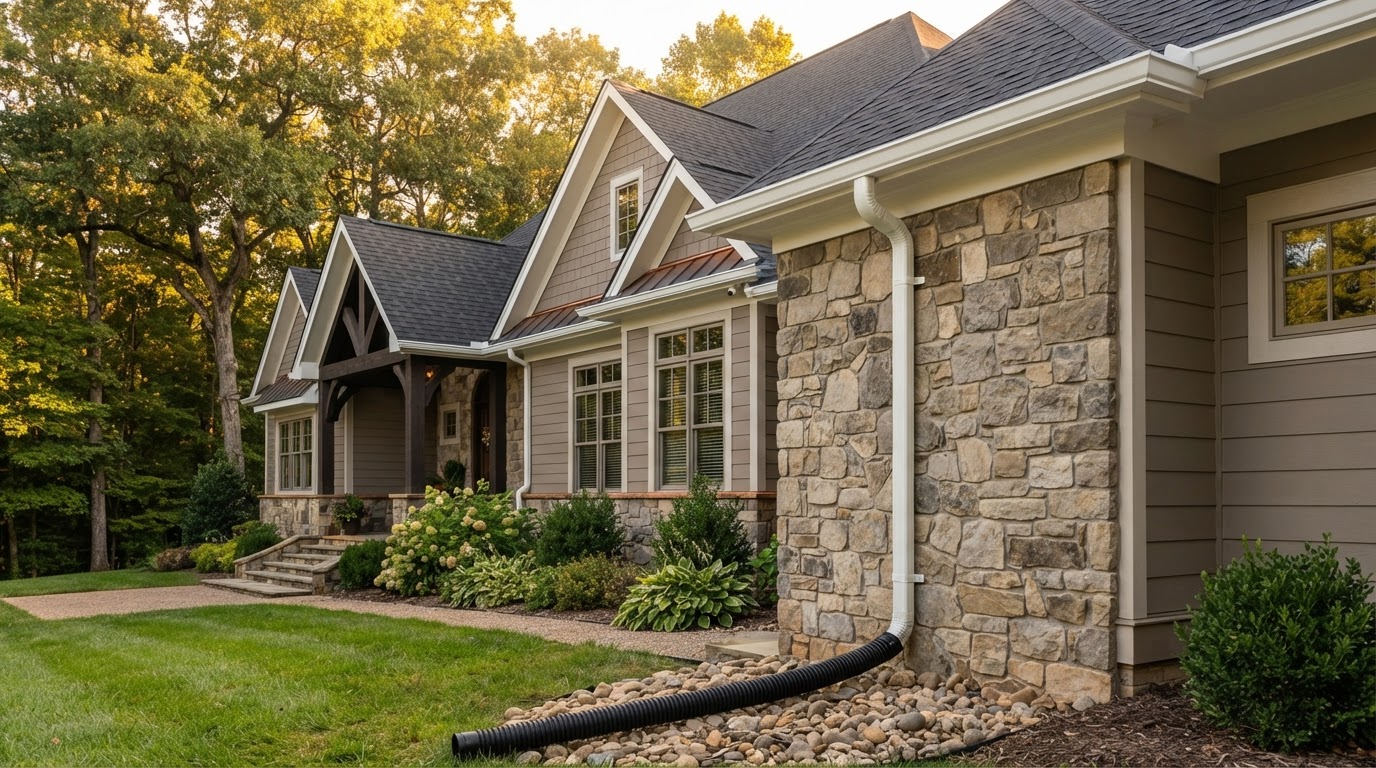
A gutter is only as good as its downspouts. If downspouts discharge right next to the foundation, all the water the gutters collected simply pools against the house. Downspouts should extend far enough to carry water away from the foundation, and on sloped lots they should outlet where the grade carries water downhill and away from the home.
In Middle Tennessee's heavy rain, undersized or poorly placed downspouts are a common cause of basement seepage, crawl space moisture, and foundation cracks. Adding the right number of downspouts for the roof area, extending them properly, and keeping them clear is just as important as the gutters themselves.
Do Gutter Guards Work in Middle Tennessee?
Middle Tennessee's established neighborhoods in Nashville, Franklin, and Brentwood are full of mature trees that drop leaves, oak tassels, pine needles, and seeds onto roofs. Without protection, those materials clog gutters and cause water to back up under the shingles and over the fascia. Quality micro-mesh gutter guards dramatically reduce clogging by keeping debris out while letting water through.
Not all guards are equal. Cheap foam or brush inserts can themselves clog, and large-hole screens let small debris in. A well-chosen micro-mesh system matched to your trees and roof can greatly reduce cleaning and prevent clog-related water damage. Gutter guards are an upgrade worth evaluating for any Middle Tennessee home with significant tree coverage.
Signs Your Gutters Need Repair or Replacement
Common warning signs include gutters pulling away from the fascia, visible sagging between hangers, water streaming over the front edge during rain, peeling paint or rust on the gutter surface, pools of water or eroding soil beneath downspouts, and water stains or rot on the fascia boards behind the gutter. Any of these can mean the gutters are undersized, clogged, poorly pitched, or simply at the end of their service life.
If gutters are pulling away, the fascia behind them may already be rotted and need repair along with the gutter replacement. A free inspection can confirm whether a targeted repair (resealing a joint, re-pitching a section, adding a downspout) will solve the problem or whether full replacement is the better investment.
How Gutters Connect to Roof Leaks and Storm Damage
Gutter problems and roof leaks are closely linked. When gutters overflow or pull away, water runs behind the gutter and soaks the fascia and roof edge, which is one of the most common sources of leaks that homeowners mistake for a shingle problem. If you are dealing with a leak, it is worth reading the Roof Leak Emergency Guide to understand immediate steps and when to call a roofer.
After storms, gutters also take a beating from wind, falling limbs, and hail. A post-storm check of the gutters and downspouts is a good habit, and a free inspection can document any damage for your records. For storm damage to the roof itself, the Storm & Hail Damage Guide covers what to look for and how the insurance process generally works.
Gutter Health Checklist for Middle Tennessee Homeowners
- Gutters are securely fastened and not pulling away from the fascia
- No sagging sections between hangers
- Water flows freely with no overflow during heavy rain
- Downspouts extend well away from the foundation
- No peeling paint, rust, or visible cracks on the gutter surface
- Fascia boards behind the gutters are solid, not soft or rotted
- No soil erosion or pooling water beneath downspout outlets
- Gutter guards are intact if installed, with no gaps or clogs
- Gutters are sized to the roof area and local rainfall intensity
- No water stains on siding beneath the roof edge
Have a question about your roof?
Terry personally answers the phone — no sales reps, no pressure.
Frequently Asked Questions
Straight answers to common questions from Middle Tennessee homeowners.
Do I really need gutters on my Middle Tennessee home?
In almost every case, yes. Nashville averages about 50 inches of rain per year based on National Weather Service climate normals. Without gutters, that water sheets off the roof and pounds the soil, siding, and foundation. Gutters and downspouts are what move it safely away. Homes with very short roof overhangs, steep grades away from the foundation, or arid climates can sometimes get by without them, but in Middle Tennessee's rainfall, gutters protect the roof edge, fascia, and foundation.
How much do seamless gutters cost in Middle Tennessee?
Seamless gutter cost depends on the linear footage, gutter size (5-inch vs 6-inch), number of corners and downspouts, whether old gutters need removal, gutter guard selection, and accessibility. Because those factors vary by home, an accurate price requires an in-person evaluation. Terry Woodall Roofing provides free roof and gutter inspections so you know the full scope upfront. Call (615) 300-6005 for a free gutter quote.
Should I choose 5-inch or 6-inch gutters?
For most larger or steeper Middle Tennessee homes, 6-inch gutters are the better choice because they hold roughly 40% more water and handle intense thunderstorm downpours without overflowing. 5-inch gutters cost a bit less and can work on smaller homes with lower roof pitches. The right size depends on your roof area, pitch, and local rainfall, which is why Terry sizes gutters to each home during a free inspection.
Do gutter guards really work with Tennessee trees?
Quality micro-mesh gutter guards can dramatically reduce clogging from the leaves, oak tassels, and pine needles common in established Middle Tennessee neighborhoods. Cheap foam or brush guards can themselves clog, so the product matters. Gutter guards do not make gutters maintenance-free, but they greatly reduce cleaning frequency and prevent clog-related water backup under shingles and over the fascia.
Can bad gutters damage my roof and foundation?
Yes. Gutters that overflow, leak, or pull away let water run behind the gutter and saturate the roof edge and fascia boards, causing rot. Downspouts that dump water too close to the house cause soil erosion, basement seepage, and foundation cracks. In Middle Tennessee's heavy rain, properly sized and pitched gutters with well-placed downspouts are one of the best investments to protect both the roof and the foundation.
How often should gutters be cleaned in Middle Tennessee?
Homes with heavy tree coverage may need cleaning twice a year, typically in late fall after leaf drop and in spring after oak tassels and seed pods fall. Homes with gutter guards and few nearby trees may need far less. The key sign it is time to clean is overflow during rain or visible plant growth in the gutter, both of which mean water is not flowing freely.
How long do aluminum gutters last?
Seamless aluminum gutters typically last 20 to 30 years or more when properly installed and maintained, though fascia condition, storm exposure, and whether the gutters stay clear of debris all affect service life. Steel gutters can last a long time but may rust if the coating is damaged, and copper can last many decades. A free inspection can tell you whether your current gutters have remaining service life or are due for replacement.
Does Terry Woodall Roofing install gutters in my area?
Yes. Terry Woodall Roofing installs seamless aluminum gutters across Middle Tennessee including Nashville, Franklin, Brentwood, Bellevue, Kingston Springs, Pegram, Fairview, Dickson, and Burns. Terry personally answers the business phone at (615) 300-6005 and offers free inspections to evaluate your current gutter system. Serving Middle Tennessee since 1983.
Terry Woodall Roofing Contractors
From the Terry Woodall Roofing Contractors Resource Center — serving Middle Tennessee homeowners since 1983
Terry Woodall Roofing Contractors brings over 40 years of hands-on roofing experience to Middle Tennessee homeowners. These resources are prepared to help homeowners understand roof maintenance, storm damage mitigation, and the insurance claims process so every home is protected. Founder Terry Woodall personally oversees the company's roofing work across Nashville, Franklin, Brentwood, and the surrounding communities.
Found this guide useful? Copy a ready-to-paste citation and attribute Terry Woodall Roofing as your source.
Terry Woodall. (2026-08-24). The Complete Gutter Guide for Middle Tennessee Homeowners (2026). Terry Woodall Roofing. https://terrywoodallroofing.com/resources/complete-gutter-guide-middle-tennessee
Related Roofing Services
If you suspect your roof needs attention, Terry Woodall offers straightforward evaluations across Middle Tennessee:
Where We Work in Middle Tennessee
Request a Call
Get straightforward answers directly from Terry.
This form is for Middle Tennessee homeowners requesting roofing help only. Marketing, sales, and vendor solicitations are not accepted and will be discarded.
Need an Honest Roof Inspection?
Speak directly with Terry Woodall today. No pushy sales representatives, just a local reputation built since 1983.
Call (615) 300-6005Text TerryWorried your gutters are overflowing, pulling away, or damaging your fascia and foundation? Terry Woodall Roofing installs seamless aluminum gutters sized for Middle Tennessee's heavy rain and offers free inspections across Nashville, Franklin, Brentwood, and surrounding communities. Serving Middle Tennessee since 1983. Call (615) 300-6005 to speak directly with Terry.